

Improving Employee Comfort and Focus with Office Blinds

The right office blinds can do more than soften a bright window. They can help control glare, manage heat from direct sunlight and make a workspace more comfortable. In winter, a closed blind adds a layer between the room and the glass, helping retain warmth. Improving employee comfort with better blinds starts with choosing light control suited to each space.
That matters because screen glare and fluctuating temperatures can affect comfort and make focused work harder. Reflective blinds can help reduce solar heat and glare while still allowing useful daylight, depending on their design and adjustment. The aim isn’t to block every window all day, but to give staff more control over changing conditions.
This guide explains how blinds can support focus and privacy, how reflective options can help manage summer heat and winter comfort, and what to consider when matching blind styles to windows and work areas. You’ll also learn how light control can contribute to a more comfortable, productive workplace throughout the year.
Key Takeaways
- Use adjustable blinds to manage glare while keeping useful natural light in the workspace.
- Consider how different window coverings can support privacy and focus in meeting rooms and shared areas.
- Explore how blinds can help reduce heat from direct sunlight and retain warmth in colder weather.
- Match the blind style and fit to each window and work area for more tailored light and temperature control.
Can blinds improve employee comfort and productivity?
Yes. Office blinds can help employees focus by managing privacy, daylight and distractions. The right choice depends on each window and the work taking place nearby.
Privacy in Offices and Meeting Rooms
Privacy blinds limit views into shared workspaces, meeting rooms and client-facing areas. In open-plan offices, they can create visual separation where permanent walls aren’t practical.
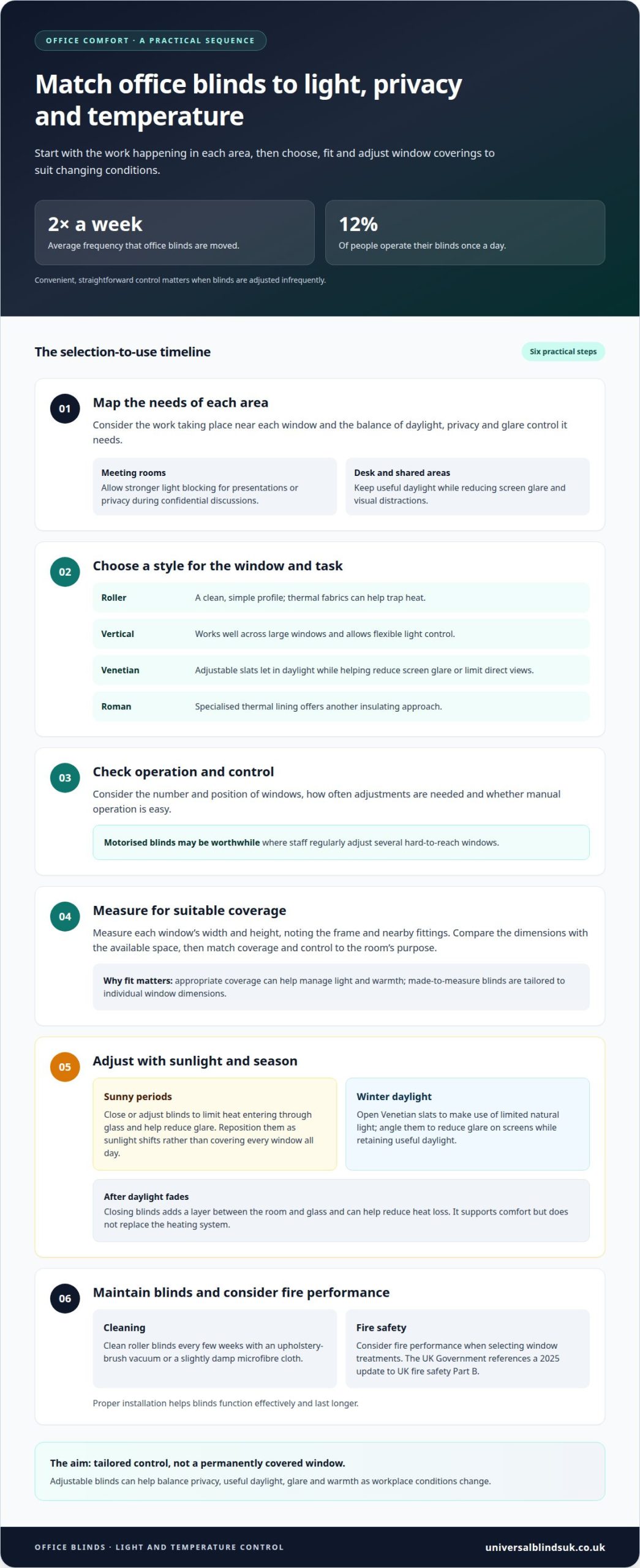
Meeting rooms may need greater privacy during discussions or presentations, while a shared desk area may benefit from adjustable screening. Blinds can also reduce visual distractions from passersby outside. Office blinds are moved an average of twice a week, while only 12% of people operate their blinds once a day. This helps explain why simple, convenient control matters.
Office Blind Types and Features
Different office blind styles offer different ways to manage light, privacy and window coverage. Roller blinds have a clean, simple profile suited to modern offices, while vertical blinds work well across large windows and allow flexible light control.
Motorised blinds can be worthwhile where staff regularly need to adjust several hard-to-reach windows. Whether they suit the workplace depends on the number and position of windows, how often adjustments are needed and how easy the blinds are to operate manually.
Fire safety, cleaning and maintenance also matter. The UK Government references a 2025 update to UK fire safety Part B, so consider fire performance when selecting window treatments. Clean roller blinds every few weeks with an upholstery-brush vacuum or a slightly damp microfibre cloth. Proper installation helps blinds function effectively and last longer.
Matching Blinds to Office Functions
Match blinds to each office function by considering the light control and privacy the activity requires. A meeting room used for presentations may need stronger light blocking, while a desk area may need daylight with less screen glare. Commercial blinds come in different colours, materials and styles to complement office décor.
When choosing blinds for office windows, measure each window’s width and height, noting the frame and nearby fittings. Compare the dimensions with the space available for the blind, then match the coverage and control to the room’s purpose. Made-to-measure blinds can be tailored to individual window dimensions.
Why are office blinds important in the winter?
Winter brings shorter days and colder conditions, making adaptable window coverings useful in UK workplaces. Blinds help staff balance daylight, privacy and warmth throughout the working day.
Adjustable Light Control with Venetian Blinds
Venetian blinds use adjustable slats to control how much daylight enters a room. In winter, opening the slats can make better use of limited natural light, while angling them can reduce glare on computer screens.
This flexibility matters as the sun’s position changes throughout the day. Staff can adjust the slats instead of fully closing the blind, helping maintain useful light and a comfortable working environment.
Lighting Challenges in Modern Offices
Modern offices often combine large windows, computer screens and artificial lighting. On a bright winter day, sunlight can reflect off screens. On a darker afternoon, relying only on artificial light can make work feel less comfortable.
Public Health England states that poor lighting levels can cause discomfort and fatigue. Adjustable blinds help employees manage daylight as conditions change, while suitable artificial lighting supports visibility when daylight fades.
Balancing Natural Light and Privacy
Balancing natural light and privacy means letting daylight in without exposing employees or meeting-room activity. Partly tilted Venetian slats can admit light while limiting direct views through a window.
In a meeting room, blinds can be closed for confidential discussions or presentations, then reopened to restore daylight. This gives the space a practical balance between privacy and openness, rather than keeping the window covered all day.
Light Control and Workplace Comfort
Light control supports workplace comfort by reducing harsh glare while preserving useful daylight. In winter, closing blinds after daylight fades can also add a layer between the room and the glass, helping reduce heat loss through windows.
That added layer can support comfort alongside the building’s heating system, but it doesn’t replace heating. For a closer fit around individual windows, made-to-measure blinds offer a tailored option for managing light and warmth.
Temperature regulation and employee comfort
Temperature differences across a workspace can make one desk comfortable and another distracting. Windows are part of that balance: direct sunlight can warm a desk, while glass can feel cold in winter. Blinds help manage these effects at the window, supporting a steadier work environment without replacing the building’s heating or cooling system.
During sunny periods, closing blinds can limit heat entering through the glass. This can help prevent a desk near the window from becoming uncomfortably warm while colleagues elsewhere remain cool. Staff can adjust the coverings as sunlight shifts instead of keeping every window fully covered all day.
In colder weather, a closed blind creates an additional layer between the room and the window. Fitted blinds combined with thermal fabric can help block draughts and retain warmth, allowing the central-heating system to work more efficiently. Thermal roller blinds use dense, tightly woven fabrics designed to trap heat; Roman blinds with specialised thermal lining offer another insulating approach.
Fit affects how well a blind covers a window. Made-to-measure blinds are tailored to individual window dimensions, helping achieve appropriate coverage. This can be useful in offices where draughts near a window make nearby workstations less comfortable. The result depends on the window, the fit and the fabric, not appearance alone.
Choose a covering by considering the workspace’s main temperature issue. A sunlit meeting area may need adjustable coverage during bright periods, while a draught-prone desk may benefit from a closer fit and insulating fabric. These choices also contribute to energy efficiency by helping manage heat gain and loss through windows, rather than relying solely on heating or cooling.
Style still matters. A carefully selected colour and fabric can complement the office while serving a practical purpose. Match the blind’s coverage and material to the window’s conditions, then adjust it as sunlight and indoor temperatures change.
How do office blinds control heat, sunlight and temperature?
Office blinds manage sunlight at the window, helping limit glare and heat gain in bright conditions. Direct sun can raise temperatures near a glazed façade, making a desk beside the window less comfortable than one farther inside. Adjusting the blind changes how much sunlight reaches the glass and work area. Improving employee comfort with better blinds starts with matching coverage to the room’s exposure.
Reflective blinds redirect some incoming sunlight, helping reduce heat and glare while allowing daylight into the room. This can help in a south-facing office where sunlight reaches screens or warms a meeting table. The result depends on the window’s position, sun exposure and blind coverage.
During summer, lowering a blind over a sunlit window can help prevent the room becoming uncomfortably warm. In winter, closing blinds after daylight fades adds a layer between the workspace and cold glass. An average home or office building loses about 25-30% of its heat through windows and doors, so coverings can contribute to managing heat loss.
Blinds can also reduce the need for artificial lighting when they allow useful daylight into a room. Venetian slats can be angled to limit direct glare, while Roller blinds provide straightforward coverage. Improving employee comfort with better blinds also means choosing a control style that suits each window and workspace.
Consider the window’s orientation, nearby screens and where employees sit. Match the blind’s coverage and operation to the room’s pattern of sunlight, rather than treating every window alike. This helps manage heat gain and loss alongside the building’s heating and cooling systems.
For tailored coverage across different office windows, explore made-to-measure blinds suited to your workspace.
Universal Blinds UK
Universal Blinds UK helps businesses choose window coverings suited to their office windows, light levels and privacy needs. Made-to-measure blinds and custom shutters can suit different spaces. Free office consultations, measuring and quotes, followed by professional fitting, help tailor the solution to the workplace.
If glare, changing temperatures or uneven window coverage are affecting your workplace, a tailored solution can address those specific conditions. The right choice depends on the window and how the space is used, from focused desk areas to meeting rooms.
Contact Universal Blinds UK to discuss options for your office.
Make workplace comfort part of your next decision
A practical approach to improving employee comfort with better blinds begins by noticing where conditions disrupt the working day. Is one workstation regularly affected by changing light? Does a shared space need more control during particular activities? These observations can help prioritise which windows to address first.
Consider window coverings as one part of workplace planning, alongside desk positions and how rooms are used. A targeted change can address a specific concern without treating every office window alike. Involving employees in identifying uncomfortable areas can also ground the decision in how the space actually works.
For help considering suitable options for your workplace, contact Universal Blinds UK. A thoughtful next step can bring greater control to the spaces where employees need it most.
Frequently Asked Questions
How do better blinds improve employee comfort and productivity in UK workplaces?
Better blinds give employees more control over conditions around their desks, which can support comfort and concentration. Staff in a shared office, for example, may want different light levels from colleagues using a presentation room. Blinds can also screen visual distractions from outside. They’re one practical part of workplace design, alongside desk placement, lighting and how each room is used.
Which blinds are best for reducing glare on office screens?
Adjustable Venetian blinds are useful because their slats can be angled to limit direct sunlight on screens. Vertical blinds also offer flexible light control across large windows, while Roller blinds provide straightforward coverage for a bright window. The most suitable style depends on the window and screen positions. Positioning desks away from direct reflections can also help manage glare.
What are the best blinds for privacy while allowing natural light into an office?
Venetian blinds can balance privacy and daylight by letting staff angle the slats instead of closing the whole window. This can suit street-facing offices where employees want natural light without a clear view inside. In meeting rooms, adjustable blinds can screen the space during confidential conversations, then be opened afterwards. The preferred balance depends on the room’s exposure and use.
How do roller, Venetian, vertical and solar blinds compare for workplace use?
Roller blinds provide straightforward window coverage and suit many modern offices. Venetian blinds offer adjustable slats for more precise light control, while vertical blinds can cover large windows with flexible adjustment. Solar blinds are designed for managing incoming sunlight; their exact effect depends on their fabric and construction. Choose by considering window size, glare, privacy and how staff use the space.
Can blinds improve energy efficiency and reduce heating or cooling costs in UK offices?
Blinds can support energy efficiency by helping manage heat entering through sunny windows and warmth escaping through glazing. This may reduce reliance on heating or cooling, but the effect depends on the building, window fit, blind material and how coverings are used. For example, closing a blind over a sun-exposed window can help limit summer heat gain, while closing it after daylight fades adds a layer at the glass.
What UK workplace rules cover glare, lighting and window blinds?
The page references UK Part L and Part O in connection with solar shading and building energy efficiency. For commercial window treatments, it also highlights fire performance under Part B and the referenced standards BS 5867 and EN 1634-1.