

How Materials, Installation and Security Affect Shutter Costs
The cheapest shutter isn’t always the most cost-effective choice. Justifying the cost of commercial shutters means looking beyond the initial quote at the opening’s size, frequency of use, material and specification, and the work needed to install it.
It’s reasonable to want a clear explanation of what you’re paying for, especially when security requirements may also affect insurance decisions. This guide explains how shutter type, construction and installation complexity influence the overall cost, and why a security rating may matter when considering your premises and insurance. You’ll also see what to look for in a quotation so you can understand how each element relates to your needs.
Key Takeaways
- Assess the opening, access conditions and installation requirements to understand why fitting work can affect a shutter quote.
- Compare shutter options by size, operation and specification, not just by the initial price.
- Understand how security ratings relate to protection needs and may influence insurance considerations.
- Consider how construction materials, finishes and frequency of use shape the suitability and overall cost of a shutter.
Installation complexity
Installation complexity covers the labour and adjustments needed to fit a shutter to a particular opening. Access, electrical work and structural changes can all affect the quotation.
Installation Costs and Timescales
Installation costs reflect the time and work required to fit the shutter safely and correctly. Standard roller shutter installations typically take 1-3 days on-site, while commercial projects can take 3-6 weeks overall when surveys, electrical installation and testing are included.
Those periods describe different stages, not a contradiction: the first is fitting time, while the longer estimate covers the project process. A commercial roller shutter with a motor and remote operation may need electrical work alongside fitting. The price depends on the opening, shutter specification, access and work required, and is given after a quotation request.
Site Complexity and Bespoke Installation
Site complexity means adapting the installation to the building rather than fitting a shutter into a straightforward, prepared opening. Restricted access, uneven surfaces or an existing structure that needs adjustment can add labour and affect the installation plan.
For example, fitting a shutter above a busy commercial entrance may require careful coordination around access, while a garage opening with clear space may be more straightforward. A bespoke fit may also involve matching the shutter to an unusual opening or integrating it with an existing system. These details affect the work required, not just the shutter itself.
A detailed site survey helps establish the opening measurements, access conditions and electrical requirements before installation. A quotation that separates the shutter, fitting and any additional work makes it easier to understand why proposals differ.
For commercial premises, distinguish the installation duration from the full project timescale. Planning electrical work and site access early can help limit disruption. A typical price range cannot account for every opening, so site conditions and the chosen specification determine the relevant cost.
Commercial and domestic shutter prices
In the UK, shutter prices vary with opening size, operation, materials and specification. A retail entrance with a wide opening, electric controls and security shutters has different requirements from a small residential window with a manual shutter. Industrial roller shutters must also suit their operating demands, so comparing products by appearance alone can hide important differences.
Residential shutters often cover smaller openings, while commercial installations may involve wider access points and more demanding use. Measurements, finish and requested features all affect cost. A manual shutter and an electric model are not a like-for-like comparison: the motor and electrical work change the specification. The same applies when comparing security levels or insulation.
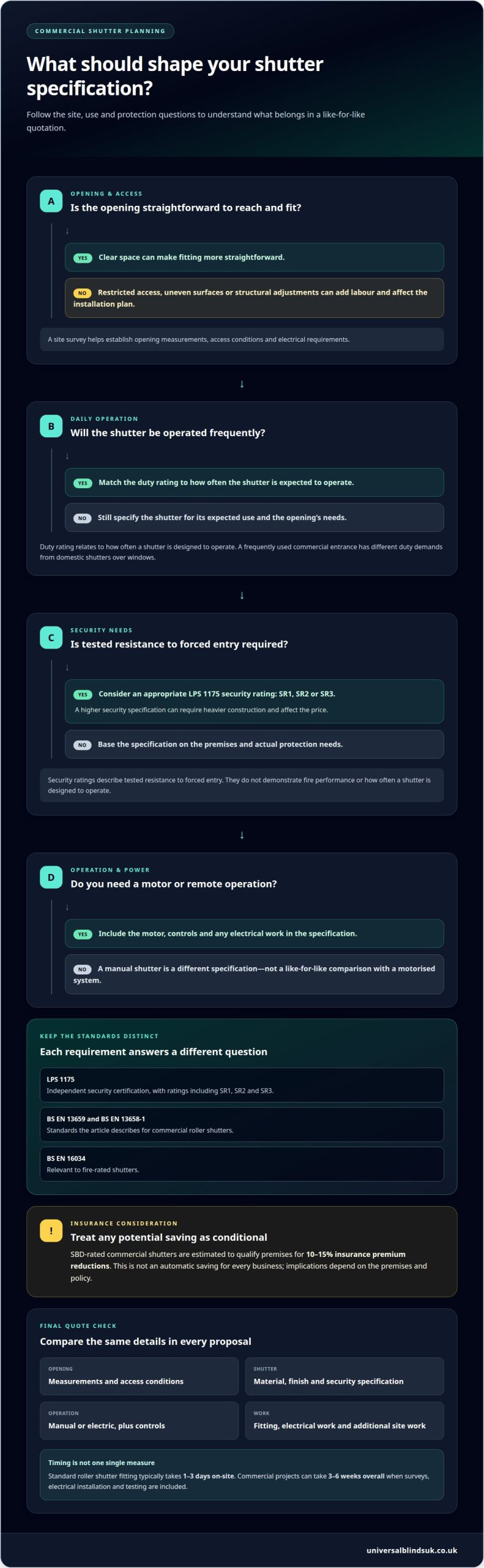
For a fair comparison, align the details in each quotation: opening measurements, shutter material, operation, finish, security specification, installation and electrical work. A basic manual shutter cannot be compared directly with a quotation for a motorised system and fitting. This helps show whether the difference reflects the product, the work or both.
The price depends on the opening measurements, chosen operation, materials, security specification and installation requirements. A quotation based on those details will give the figure for your project.
Maintenance and repair costs depend on the shutter type, fault and replacement parts required. Routine servicing can identify wear or operating issues, while repair costs vary depending on whether the problem affects the mechanism, controls or shutter itself.
In the UK, grants, tax allowances and business finance are not automatic parts of a shutter quotation. Availability and eligibility depend on the relevant scheme or finance terms and the business’s circumstances, so consider these separately from the product specification.
If you’re considering shutters for a specific opening, explore custom shutter options and how their measurements and specification can be tailored to the space.
Security ratings and insurance implications
A security rating describes tested resistance to forced entry, while a duty rating relates to how often a shutter is designed to operate. Both help match the shutter to the opening’s risks and daily use, rather than choosing on appearance alone.
LPS 1175 provides independent security certification, with ratings including SR1, SR2 and SR3. A higher security specification can require heavier construction and affect the price. Insurance implications depend on the premises and policy: SBD-rated commercial shutters are estimated to qualify premises for 10-15% insurance premium reductions, but this is not an automatic saving for every business.
Standards also relate to the shutter’s application. Commercial roller shutters are described as needing to meet BS EN 13659 and BS EN 13658-1, while BS EN 16034 is relevant to fire-rated shutters. These identifiers address different requirements, so a security rating should not be treated as evidence of fire performance or vice versa.
Insulated, fire-rated and security shutters serve different purposes, so their cost ranges differ.
A survey can help establish the opening, expected use and relevant security level. For example, a frequently operated commercial entrance has different duty demands from domestic aluminium shutters over windows. Weigh convenience, security and insulation against the site’s actual needs, since heavier shutters may also require suitable operating equipment.
Security and compliance affect value over time, not just the initial specification. A shutter suited to the opening and its operating demands can support reliable daily use, while relevant certification provides evidence of tested performance. Match each requirement to its purpose: resistance to forced entry, fire performance or regular operation.
Materials and their effect on cost
Material affects a shutter’s weight, strength, maintenance needs and suitability for its opening. Commercial roller shutters use steel, with heavier-gauge lath and reinforced guides suited to higher-use or higher-risk sites. These components influence the specification and the operating equipment needed to move the shutter. Justifying the cost of commercial shutters means weighing these practical demands against the chosen material.
Commercial roller shutters use 1.5-2 mm steel, and larger openings may need more material and a stronger motor for electric operation. Manual operation can suit an opening used occasionally, while frequent use or a heavier shutter can make powered operation more practical. The material, opening size and use pattern therefore need to be considered together.
Finishes also affect the specification. Standard roller shutter finishes are typically included in the base price, while specialist finishes can cost extra. Custom colours or powder coating may suit a retail frontage, but a specialist finish should meet a clear site need rather than add cost for appearance alone. Vision panels and extra locks can also change the specification.
Material choices differ across shutter types. Steel is common for commercial roller shutters, while wood, MDF and faux wood are used for other applications. Wood may need more maintenance and repairs; MDF is described as durable and needing little maintenance compared with wood. Faux wood offers many wood-like characteristics at a slightly lower cost. The cheapest initial option may not be the best fit if upkeep or use differs.
For a like-for-like material comparison, align the opening dimensions, material, finish, operation and security rating. This makes it clearer whether a quotation reflects stronger components, an upgraded finish or a different operating system. It also gives you a grounded basis for justifying the cost of commercial shutters, based on how the materials suit the opening, not their name alone.
For shutters tailored to your space and specification, explore custom shutter options.
Maintenance and repair costs depend on the material: wood may need more upkeep and repairs, while MDF needs little maintenance compared with wood.
Universal Blinds UK: Custom Shutters
Universal Blinds UK supplies and fits custom shutters for openings that need a tailored fit. Its free measuring service establishes the dimensions, and professional fitting completes the installation.
For a commercial space, the right option depends on the opening and the function it needs to serve. A measured assessment can clarify those requirements before you decide how the shutters should fit the space. Made-to-measure blinds are also available when a different window covering better suits the setting.
If you’d like to discuss your requirements, contact Universal Blinds UK.
Turn your requirements into a clear next step
A concise project brief can make justifying the cost of commercial shutters easier internally. Note which opening needs attention, the outcome that matters most, and which features are essential rather than optional. This gives the decision a practical foundation and keeps the next conversation focused on your premises.
Universal Blinds UK supplies and fits custom shutters and made-to-measure blinds. Its free measuring service establishes the dimensions of your windows or openings, providing a useful starting point for choosing a suitable fit. Discuss the space and your preferences before deciding how to proceed.
Share details that matter to your business, such as how the opening is used and the look you want to achieve. A clear brief helps connect your priorities with a suitable option without treating every possible feature as essential.
Contact Universal Blinds UK to discuss your requirements and take the next step with confidence.
Frequently Asked Questions
How much do shutters cost, and what affects their price?
There’s no single price for shutters; the amount depends on the opening and chosen specification. Size, material, manual or electric operation, finishes, security requirements and installation work all affect the final quote. For a useful comparison, make sure quotations describe the same measurements and features. An on-site measurement establishes the details needed to quote for your project.
What factors affect the cost of commercial shutters?
Opening dimensions, frequency of use and site demands shape the specification and cost. A shutter for a busy delivery entrance, for example, may need different operating and security features from one protecting a seldom-used store room. Building access, existing structure, finish and electrical requirements also matter. Separating the shutter, fitting and additional work in a quotation makes the cost components easier to assess.
Can commercial shutters reduce energy bills, insurance premiums or theft losses?
Shutters can provide a physical barrier against unauthorised entry, while an insulated design can help limit heat loss where the space is heated. A security specification may also be relevant to an insurer’s assessment, but the effect depends on the premises and policy. Consider potential energy savings, insurance factors and reduced exposure to theft as separate benefits; none should be assumed to offset the full purchase cost.
How long do commercial shutters last, and what is their expected return on investment?
Commercial roller shutters are estimated to last 15-20 years with annual servicing. Their return on investment depends on the initial specification, maintenance, operating demands and the value of benefits such as security or reduced heat loss. A business can assess this by comparing expected ownership costs with the practical value the shutter provides over its working life, rather than relying on a fixed payback period.
How much do commercial shutters cost to maintain and repair?
Repair costs vary depending on the fault and whether it affects the mechanism, controls or shutter itself.