

Blinds for Awkward Shaped Windows: A 2026 Guide to Bespoke Solutions
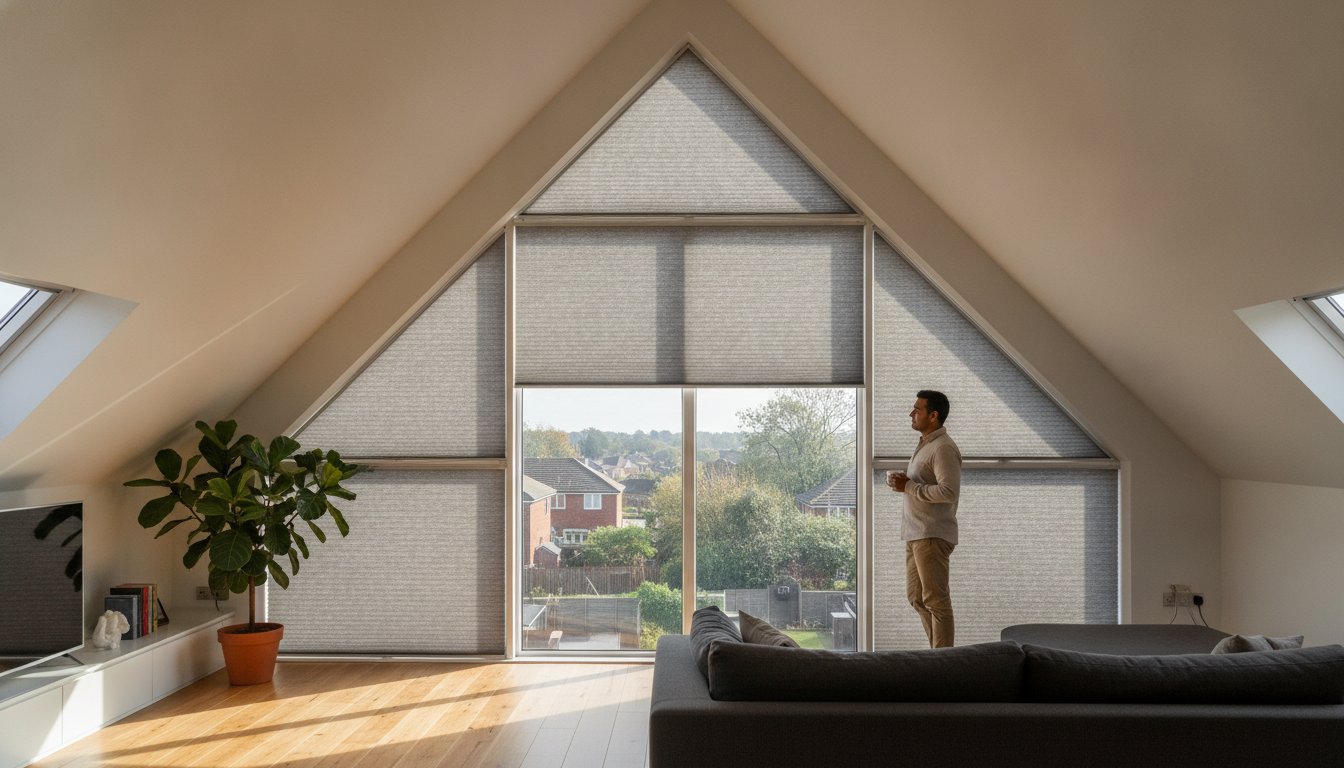
What if that triangular gable or arched window you have been struggling to cover wasn’t an architectural headache, but actually the most stunning design feature in your home? It’s common to feel a sense of frustration when standard shop-bought options fail to fit, or to worry that a complex angle will lead to unsightly light gaps and draughts. Finding the right blinds for awkward shaped windows often feels like a technical minefield, especially when you are anxious about measuring those tricky corners yourself.
We understand that your home’s unique character deserves better than a “make-do” solution. You deserve the peace of mind that comes from a professional, made-to-measure approach where every millimetre is accounted for. In this 2026 guide, you will discover how bespoke craftsmanship can transform your most challenging glass into a functional masterpiece. We will preview the latest UK child safety regulations and the rise of smart, motorised solutions that offer effortless light and temperature control. From heritage-inspired textures to minimalist finishes, you’ll see exactly why no window shape is impossible when handled with calm, expert care.
Key Takeaways
- Understand why architectural features like gables and apexes require specific tensioned systems to avoid unsightly sagging and light gaps.
- Compare the most effective styles, including pleated and vertical options, when choosing blinds for awkward shaped windows for your home.
- Learn why a professional technical assessment of your window’s substrate is the only way to guarantee a millimetre-perfect, secure fit.
- Discover the benefits of viewing fabric samples in your own room’s light to ensure your bespoke solution perfectly complements your existing decor.
- Explore how a local, heritage-based service in the West Midlands can turn complex window challenges into stunning, intentional design statements.
Understanding the Challenges of Non-Standard and Awkward Shaped Windows
Modern UK architecture often prioritises natural light, leading to a rise in stunning but complex glazing. Many homeowners in the West Midlands choose striking features like gable ends to flood their extensions with sunshine. While these designs look incredible, finding blinds for awkward shaped windows that actually work is a common struggle. Unlike standard windows, these shapes fight against gravity. A standard roller blind simply cannot stay flush against a sloping apex or an arched frame without sagging or leaving massive gaps. While you might find foundational information in a comprehensive guide to window blinds, those resources often focus on standard rectangles rather than the technical precision needed for irregular UK architectural trends.
To better understand how these challenges are overcome in practice, watch this helpful video:
Common Shapes: From Gable Ends to Portholes
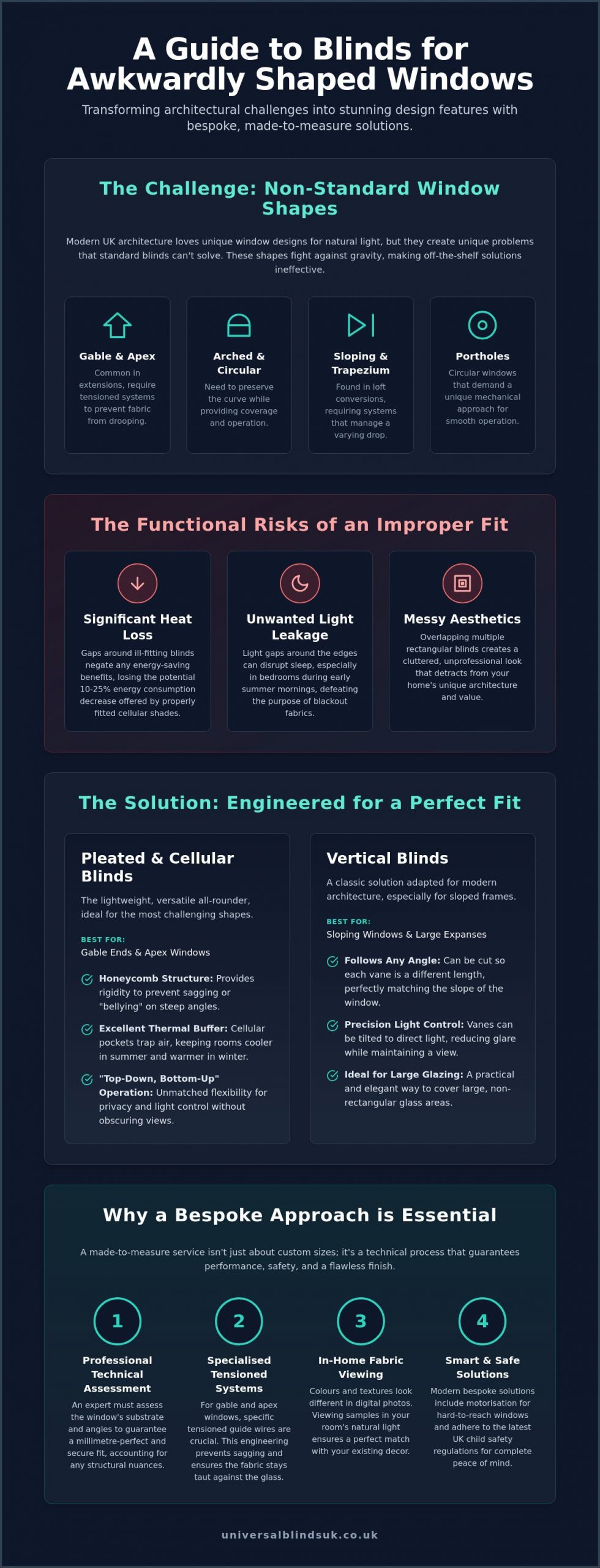
Triangular and apex windows are the most frequent challenges we see in modern kitchen-diners. These high points of a roofline require specialised tensioned systems to prevent the fabric from drooping. Arched and circular windows present a different hurdle; you want to preserve the elegant curve without completely blocking the view when the blinds are open. Sloping or trapezium windows, often found in loft conversions, require a system that can manage a varying “drop” across an uneven width. Each of these shapes demands a unique mechanical approach to ensure the blind operates smoothly every time.
The Functional Risks of “Making Do”
Trying to fit a square peg in a round hole leads to more than just aesthetic disappointment. Ill-fitting blinds are a primary cause of heat loss. Industry research indicates that energy-efficient cellular shades can decrease energy consumption by 10-25%, but these benefits vanish if there are gaps around the edges. In bedrooms, light leakage from non-standard glazing can ruin a good night’s sleep, especially during early summer mornings. Beyond performance, there’s the issue of aesthetic clutter. Attempting to overlap several rectangular blinds to cover a shaped window creates a messy, unprofessional look that detracts from your home’s value. Effective window dressing must balance light exclusion, thermal efficiency, and perfect aesthetic alignment.
Bespoke, made-to-measure blinds represent the only viable solution for managing the irregular geometry of unique architectural glazing, such as the high-performance windows and rooflights supplied by View Glazing.
The Best Blind Styles for Common Architectural Shapes
Selecting the right window dressing involves more than just picking a colour; it requires matching the mechanical capabilities of the product to the specific geometry of your glass. While standard windows offer plenty of flexibility, blinds for awkward shaped windows must be engineered to perform under the unique pressures of angles and curves. Different materials and operating systems offer distinct advantages depending on whether you are covering a sharp apex or a soft, sweeping arch.
Pleated and Cellular Blinds: The All-Rounders
Pleated fabrics are often the primary recommendation for modern UK extensions featuring gable ends. Their unique honeycomb structure is particularly effective because it remains lightweight while providing significant structural integrity. This means the fabric won’t sag or “belly” when installed at a steep angle. These cellular designs also act as a thermal buffer. Since large architectural windows are often prone to temperature fluctuations, these blinds help keep your room cool in summer and warm in winter.
One of the most functional features of this style is the “Top-Down, Bottom-Up” operation. This allows you to position the blind exactly where you need it, which is ideal for unusual frames where you might want to block a low sun but keep the top of an apex clear to show off the sky. It’s a sophisticated way to maintain privacy in overlooked spaces without sacrificing the architectural impact of your glazing.
Vertical and Venetian Options for Angled Glass
Vertical blinds remain a staple for wide, sloping expanses of glass, such as those found in lean-to conservatories or modern loft conversions. The secret lies in a “stepped” headrail system. Each individual louvre is cut to a precise, varying length, allowing the blind to follow the exact pitch of your ceiling. This provides a clean, uniform look that manages light across the entire width of the room. Venetian blinds offer similar versatility. Slats can be custom-cut to fit into the very tip of a triangular window, ensuring no light gaps remain. For shapes that are high up and hard to reach, tilt-only mechanisms allow you to control the light levels with a wand or motorisation without needing to fully retract the blind.
Custom Shutters: An Elegant Alternative
For perfect arches, circular portholes, or even hexagonal frames, custom shutters are frequently the most elegant solution. While fabric blinds can sometimes mask the shape of a window, shutters are built into a fixed frame that mirrors the masonry. This preserves the architectural “statement” of the window even when the louvres are closed. They provide a permanent, high-quality finish that feels like a part of the building’s structure rather than an add-on. If you’re weighing up the benefits of a more solid installation, A Homeowner’s Guide to Elegant Window Shutters provides a detailed look at how these can be tailored to irregular openings. If you’re unsure which path to take, our experts can guide you through the options during a free measuring service consultation at your home.
Why Made-to-Measure is Essential for Irregular Window Frames
It’s natural to feel a little hesitant when considering the cost of bespoke window treatments. Many homeowners initially look at standard options to save money, but with blinds for awkward shaped windows, the “made-to-measure” label is about much more than luxury. It’s a technical necessity. When you’re dealing with a gable or a sloping apex, a discrepancy of just a few millimetres can lead to light gaps that ruin the room’s aesthetic or mechanisms that jam after just a few weeks of use.
Investing in a professional service ensures that the unique geometry of your glazing is respected. DIY kits are almost exclusively designed for 90-degree angles and standard recesses. Trying to adapt these for a trapezium or a triangular window often results in unnecessary drilling and potential damage to expensive uPVC or aluminium frames. By choosing a tailored approach, you’re safeguarding your home’s structural integrity while ensuring a seamless, professional finish that adds genuine value to your property.
The Precision of Professional Measuring
Measuring a standard rectangle is straightforward, but capturing the exact radius of a circular porthole or the pitch of a vaulted ceiling requires specialist tools and experience. For particularly complex arches, our team often creates physical paper templates. This traditional, heritage-led technique ensures we account for “clearance”, the tiny gap needed for the blind to move, and “overlap”, which prevents light from bleeding around the edges. This level of detail is why The Benefits of Professional Blind Fitting: Why DIY Can’t Compare to a local, expert-led installation.
Long-Term Durability and Warranty
Bespoke blinds are engineered to handle the specific gravity and tension challenges of their shape. While an off-the-shelf blind might look acceptable on day one, the lack of proper internal tensioning often leads to a “sagging” effect within months. Made-to-measure systems use reinforced components designed to stay taut and functional for years. This technical reliability comes with the added reassurance of a professional guarantee. If a component doesn’t perform as expected, you have the peace of mind that a local specialist is on hand to rectify it, ensuring your stunning architectural features remain both beautiful and practical for the long term.
The journey to perfecting your home’s unique architecture shouldn’t be a source of stress. While the technical side of blinds for awkward shaped windows is complex, the process of choosing them should feel inspiring and effortless. We believe in creating a low-pressure environment where you can explore options at your own pace. This begins with an in-home consultation, allowing you to see fabric samples in the actual light of your room. A swatch that looks perfect in a bright showroom might appear entirely different against the specific tones and shadows of your West Midlands home.
During this visit, we perform a detailed technical assessment of your window’s substrate. Whether your frames are uPVC, traditional wood, or modern aluminium, each material requires a specific approach to ensure a secure, long-lasting installation. Our heritage as a local, family-run business means we prioritise transparency over a quick sale. You won’t face high-pressure tactics; instead, you’ll receive honest advice on what will work best for your specific architectural challenges.
Preparing for Your In-Home Appointment
Before your specialist arrives, it’s helpful to consider your primary goal for the space. Are you looking for total light exclusion in a bedroom gable, or is thermal efficiency your main priority for a large kitchen extension? Clearing the area around your windows is also a great first step. It allows us to use precision laser measuring tools to capture every angle without obstruction. If your windows are high-reach apexes or skylights, this is also the perfect time to consider motorisation. Modern smart systems allow you to control your blinds with a simple remote or app, removing the need for long cords in hard-to-reach areas.
The Expert Assessment: More Than Just a Tape Measure
A professional assessment looks beyond simple dimensions. We check for potential obstructions that could interfere with the blind’s operation, such as protruding handles, trickle vents, or inward-opening frames. This is where we decide on the best mounting position, whether that’s tucked neatly inside the recess or fixed outside to cover the entire opening. Once we’ve assessed the technical requirements and you’ve selected your preferred materials, we provide a transparent, no-obligation quote. From that initial measurement to the final professional fitting, we manage every step to ensure your bespoke solution is implemented with millimetre precision.
Ready to see how we can transform your space with a perfect fit? Book your free measuring service today to get started with a local expert you can trust.
Bespoke Blinds and Shutters in the West Midlands: The Universal Blinds UK Approach
Universal Blinds UK is a family-run business rooted in the heart of the West Midlands. We don’t believe in the one-size-fits-all approach of national retailers. Instead, we lean into our heritage to provide a truly personal service. When you are looking for blinds for awkward shaped windows, you need more than just a product; you need a specialist who understands the local property landscape. From the high-ceilinged Victorian villas of Walsall to the sleek, modern glass-fronted extensions in Birmingham, we’ve spent years perfecting the art of the bespoke fit.
Serving Walsall, Birmingham, and the Surrounding Areas
Our team possesses an intimate knowledge of West Midlands architecture. We understand the specific challenges posed by traditional bay windows in older terraces and the complex gable ends of contemporary builds. Being local allows us to offer a level of convenience that national companies simply can’t match. We provide a showroom experience alongside a dedicated in-home service, ensuring you get expert advice right where it matters most. For those seeking a tailored solution, choosing Your Local Blinds Experts: The Smarter Choice for Blinds Near You means you are working with professionals who are invested in their community’s reputation.
Why Our Heritage Matters for Your Home
A reputation built on trust and word-of-mouth is the cornerstone of our business. We know that inviting someone into your home requires confidence, which is why we maintain a strictly low-stress sales environment. Our goal is to guide you, not pressure you. Our professional fitters are trained to handle the most irregular geometry, ensuring a “right first time” experience. This technical expertise is vital when installing made-to-measure blinds in challenging spaces where standard options would fail. By focusing on quality over volume, we ensure that every client feels secure in their decision-making process.
We believe that every window shape, no matter how unusual, is doable with the right expertise. By choosing a heritage-led specialist, you’re opting for a seamless finish and effective light control that transforms your house into a home. We invite you to experience our customer-first approach for yourself. If you’re ready to find the perfect blinds for awkward shaped windows, our team is here to help. Book your free, no-obligation home consultation today and take the first step toward a stunning architectural design feature.
Transform Your Home’s Unique Architecture Today
Your home’s architectural quirks are what make it special, and they shouldn’t be hidden behind ill-fitting, standard solutions. We have explored how a made-to-measure approach is technically essential for ensuring thermal efficiency and complete light control. By choosing blinds for awkward shaped windows that are specifically engineered for your frame’s geometry, you turn a complex challenge into a sophisticated design statement. Whether you are managing a steep apex or an elegant arch, the right bespoke fit ensures your window remains a stunning focal point for years to come.
For readers interested in extending this level of custom shading to their outdoor spaces, you can visit Awnings And More Inc. to see how bespoke patio covers can enhance a home’s exterior functionality.
As a family-run business serving Walsall and the wider West Midlands, we take pride in our heritage-led, personal approach. You can rely on our calm expertise to guide you through every step, from the initial technical assessment to the final implementation. We provide a free, no-obligation measuring service and include professional fitting as standard to ensure your project is right the first time. It’s time to stop worrying about complex angles and start enjoying the elegance of a perfect finish.
Book Your Free In-Home Consultation in the West Midlands Today and let our specialists bring your vision to life with confidence and care.
Frequently Asked Questions
Can you get blinds for triangular gable end windows?
Yes, you can certainly install blinds on triangular gable ends using specialised pleated or cellular systems. These designs use tensioned cords that allow the fabric to stay flush against the angled slope without sagging. This ensures a clean, professional look that provides full coverage right into the sharpest points of your roofline.
Are shutters better than blinds for arched windows?
Shutters often provide a superior finish for arched windows because they are built into a fixed frame that mirrors the masonry. While fabric blinds can sometimes soften the look of a curve, shutters preserve the architectural statement of the arch even when the louvres are closed. They offer a permanent, structural solution that feels like a part of your home’s original design.
How much do bespoke blinds for awkward windows cost in the UK?
Bespoke solutions for irregular shapes typically carry a premium of 25% to 100% over standard rectangular blinds. This reflects the advanced engineering and technical precision required to ensure a perfect fit. While the initial investment is higher, the long-term value lies in the improved thermal efficiency and the elimination of unsightly light gaps common with “make-do” options.
Can motorised blinds be fitted to unusually shaped windows?
Yes, motorisation is an excellent choice for blinds for awkward shaped windows, especially those positioned in high-reach gables or skylights. Modern smart systems allow you to adjust your light levels via a remote or a smartphone app. This removes the need for long, dangling cords and makes it effortless to manage privacy in hard-to-reach areas of your home.
What is the best way to cover a circular or porthole window?
Custom shutters are generally the most effective way to cover a circular or porthole window. Because the frame is manufactured to the exact radius of your glazing, it maintains the circular aesthetic while allowing you to tilt the louvres for light and privacy. Specialized pleated blinds can also be used, though they often require a fixed point that may slightly alter the circular silhouette.
How do you measure an angled window for blinds correctly?
Professional installers use laser measuring tools or physical paper templates to capture the exact pitch and radius of an angled frame. DIY measuring is rarely accurate enough for non-standard shapes, as even a two-millimetre error can cause the blind to jam. A technical assessment by a specialist ensures that “clearance” and “overlap” are perfectly balanced for a smooth operation.
Are there blackout options for shaped windows?
Yes, you can achieve a blackout effect in shaped windows by using honeycomb fabrics or custom shutters. Cellular blinds are particularly effective when fitted with side tracks that prevent light from bleeding around the edges. For blinds for awkward shaped windows in bedrooms, these bespoke systems provide the necessary darkness for a restful night’s sleep despite the complex glass shape.
Do I need a specialist fitter for non-standard window shapes?
A specialist fitter is highly recommended to manage the unique gravity and tension challenges of irregular glazing. Standard fitting techniques don’t account for the mechanical stresses that angled headrails or curved frames place on a blind. Professional installation protects your warranty and ensures that your bespoke window dressing operates reliably without sagging or sticking over time.