

Blackout shutters for nurseries: choose a quiet, easy fit
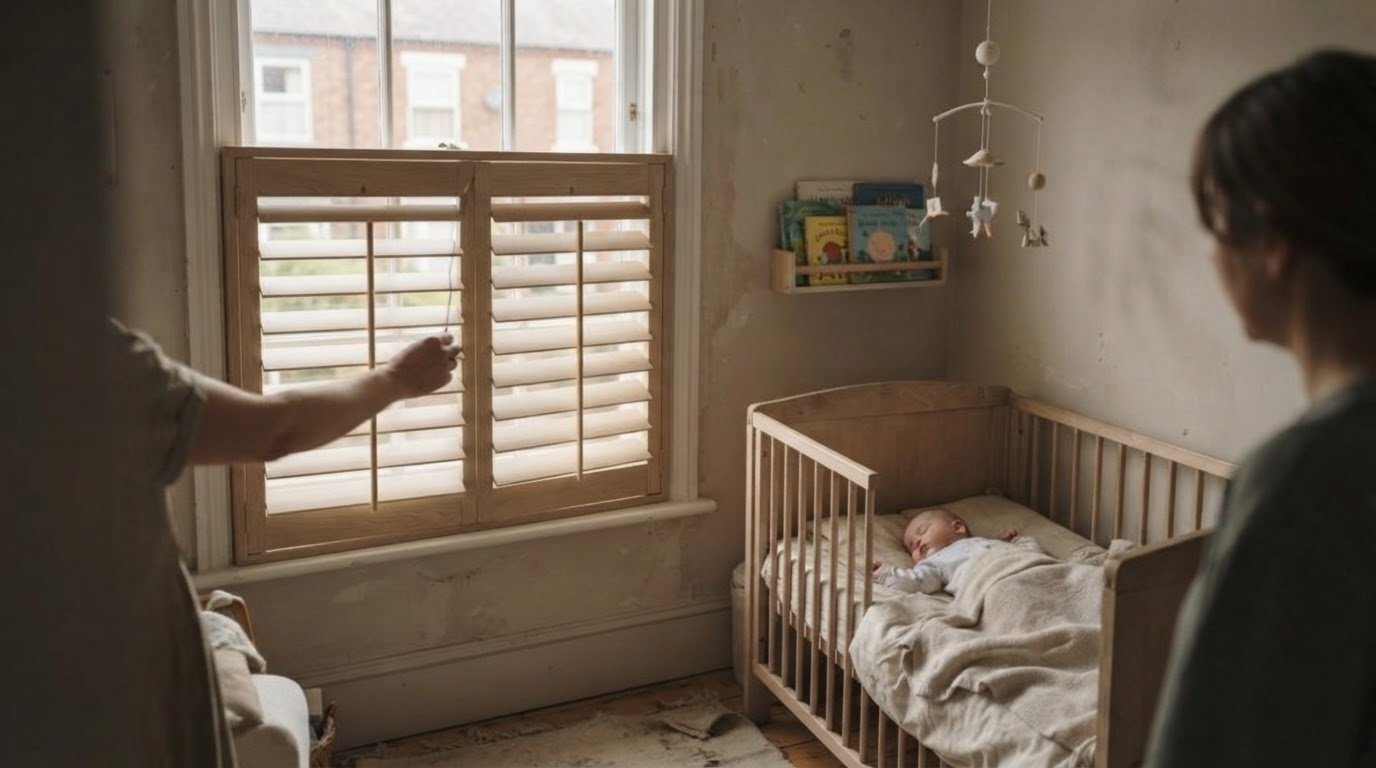
Blackout shutters for nurseries need more than a darkening finish: how closely they fit the window matters too. Gaps around the edges can let daylight in, while quiet, easy operation helps keep everyday use from disturbing a sleeping child. A professional measurement is a useful starting point for a fit tailored to your window.
A balance between light control, a neat finish and straightforward operation matters in a nursery. This guide explains how window shape and recess affect a shutter’s fit, and what to compare in made-to-measure options. Consider how the shutters operate and how their design may help limit light around the edges before choosing what suits your nursery.
Key Takeaways
- Quiet operation and a well-planned fit can help limit disruption around naps and bedtime.
- Professional measuring takes account of the recess’s narrowest point, its depth and the window style.
- Compare nursery-friendly designs for light control, ease of cleaning and safe operation.
- Plantation shutters offer a way to manage light and privacy, while the right option depends on your window and priorities.
1. Easy installation and quiet operation
For a nursery, a neat fit and smooth movement matter during naps and bedtime. Before installation, the window, fixing points and nearby handles need to be assessed. The shutters can then be positioned to avoid interference with the window, with each panel checked to ensure it opens and closes properly. This helps prevent repeated adjustments after fitting.
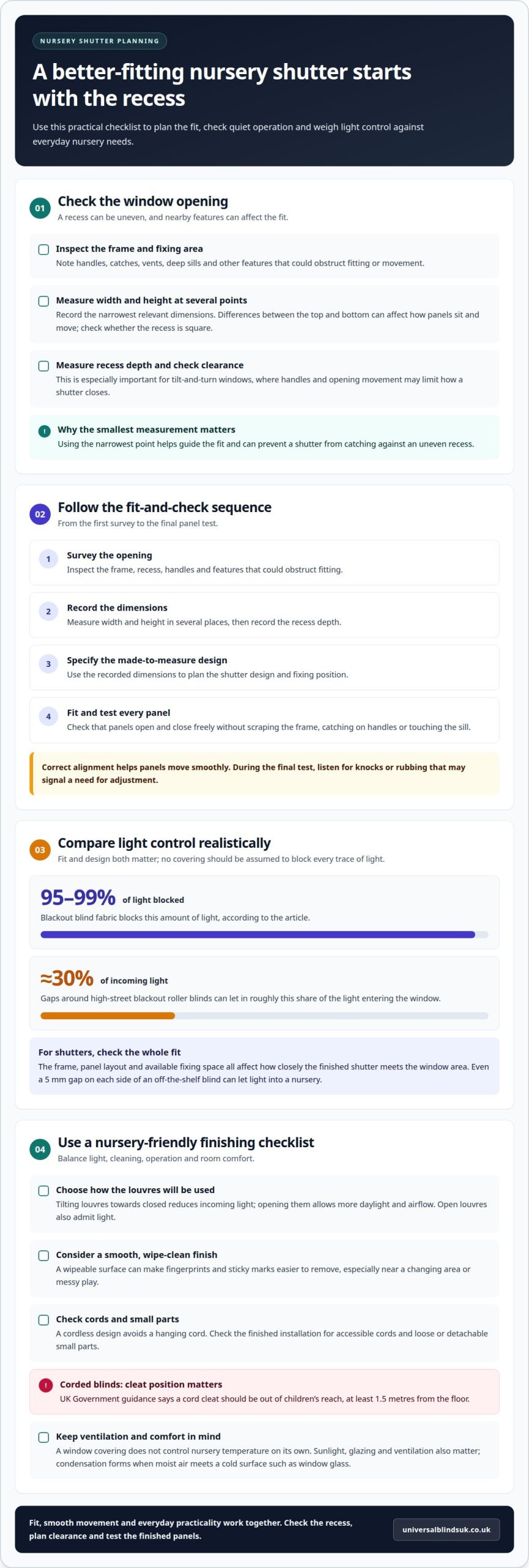
Blackout shutters can provide light control and privacy, but darkness depends on their fit and design. Blackout blind fabric blocks 95-99% of light, while gaps around high-street blackout roller blinds can let in roughly 30% of the light entering the window. Curtains can overlap window edges, while shutters rely on their frame and closed panels. No covering should be assumed to eliminate every trace of light.
Light gaps are one consideration; room temperature and condensation are others. A window covering does not control a nursery’s temperature on its own, which also depends on sunlight, glazing and ventilation. Condensation forms when moist air meets a cold surface, such as window glass. Keep ventilation and room comfort in mind when choosing a close-fitting covering, especially in a sunny room.
Quiet operation starts with correct alignment. A fitter checks that panels move freely and do not scrape the frame or catch on handles. During the final operation test, they can open and close each panel and listen for knocks or rubbing. For example, a panel that touches the sill may need adjustment before the room is used for sleep.
Safety matters alongside convenience. If the window covering uses a cord, UK Government says its cleat should be positioned out of children’s reach, at least 1.5 metres from the floor. Cordless operation avoids a hanging cord, while a carefully fitted shutter can be opened or closed without pulling a chain. A quiet, simple movement is particularly useful during a sleeping child’s bedtime routine.
Blind Technique recommends choosing nursery blinds that are easy to install to minimise disruption to nap times. It also recommends blinds that operate as quietly as possible, so their use does not disturb a child at bedtime.
How professionals measure a window recess for blackout shutters
Professional measuring starts with the window recess, the space inside the frame. Its width is checked at several points, as openings in older UK homes can be uneven. The narrowest measurement helps guide the fit and prevent a shutter from catching against the recess. Differences between the top and bottom can also affect how panels sit and move.
Height is also checked at more than one position. The fitter notes the smallest relevant dimensions and examines whether the recess is square. They also measure its depth, especially for tilt-and-turn windows, where handles and opening movement can affect clearance. A handle projecting into the recess, for example, may restrict how a shutter closes.
Light control depends partly on how closely the finished shutter meets the window area. Even a 5 mm gap on each side of an off-the-shelf blind can allow light into a nursery. For shutters, the professional considers the frame, panel layout and available fixing space together. They also look for obstructions such as window vents, catches and deep sills.
The process follows a clear sequence:
- Inspect the frame, recess, handles and any features that could obstruct fitting.
- Measure the width and height at several points, then record the recess depth.
- Use the recorded dimensions to specify a made-to-measure design and its fixing position.
- After manufacture, fit the shutters and check that panels close and move freely.
These steps answer how blackout shutters are measured, ordered and installed: a professional surveys the opening, uses its dimensions to specify the design, then fits and tests the finished shutters. Accurate measurements matter most where the recess varies or a tilt-and-turn window needs extra clearance. A professional window measuring service can help establish the dimensions before a made-to-measure choice is finalised.
3. Nursery-friendly designs
Choose a finish that suits the nursery’s daily routine as well as its appearance. A smooth, wipe-clean surface makes fingerprints and sticky marks easier to remove. A simple finish around the window can be practical near a changing area or cot. A suitable design depends on secure fitting and operation, not appearance alone.
Nursery shutters use adjustable louvres to control privacy and daylight. Tilting them towards closed reduces incoming light; opening them allows more daylight and airflow. There is a trade-off: open louvres let air circulate, but they also admit light. For a darker sleep space, close the louvres while maintaining the room’s usual ventilation.
Shutters can help manage light and privacy, but they do not regulate room temperature by themselves. Consider the window’s sun exposure and the nursery’s comfort in summer and winter. A tightly closed covering may reduce airflow at the window, so keep ventilation in mind when setting up the room. UV-protective and dimout fabrics are other features to consider when comparing nursery window coverings.
For child safety, a design without operating cords avoids a hanging cord within reach. UK Government guidance on cord cleats concerns corded blinds; a cleat should be positioned out of children’s reach at least 1.5 metres from the floor. This does not, by itself, establish whether a complete shutter design meets every safety requirement. Check the finished installation for accessible cords and loose or detachable small parts.
Cheerful patterns and calming colours can make the window feel part of the nursery rather than purely practical. Keep maintenance in mind: a wipeable finish is useful near messy play, while a simple colour can work with changing bedding and wall décor. When choosing blackout shutters for nurseries, weigh light control, cleanability and operation together, then choose a finish suited to everyday use.
A smooth, wipe-clean finish is easier to maintain, especially near changing areas or messy play. For safety, choose a design without operating cords, and ensure the installation is secure with no accessible cords or loose, detachable small parts.
4. What types of blackout shutters are available for nurseries in the UK?
Plantation shutters are an option for UK nurseries where light and privacy matter. Their panels sit within a frame, and adjustable louvres tilt to change how much daylight enters. This differs from a fabric covering that raises or lowers across the window. Shutters can stay in place while you adjust the louvres.
Light control is not the same as complete blackout. Closed louvres reduce incoming daylight, but light may still pass around the shutter frame or through small spaces between components. The result depends on the window shape, fitting position and shutter design. A professional assessment can identify where light may enter, rather than treating “blackout” as a guarantee of a fully dark room.
Plantation shutters can suit different window openings, including nursery windows where daytime privacy matters. Their arrangement needs to work with how the window opens and the space around it. A projecting handle may affect the shutter’s position, while a deep sill can influence how the panels sit. These details help determine a practical configuration.
When comparing shutter designs, consider how the louvres adjust, how the panels open and how the frame meets the window edges. A close fit supports better light control, while movable louvres let you balance privacy and daylight. For a nap, angle the louvres towards closed. During daytime play, open them to bring more light into the nursery.
Plantation shutters offer a structured alternative to softer window coverings, but they are not the right choice for every room. Consider whether adjustable daylight, privacy and panels that open for window access suit your needs. Let the window’s shape and the nursery’s routine guide your decision. A measured design can be tailored to the opening, and the final fit affects how well it manages light.
Blind Technique recommends cheerful, comforting designs and says nursery blinds are available in a variety of themes, providing an alternative to shutters.
Universal Blinds UK: Custom Shutters
Universal Blinds UK supplies and fits custom shutters, making it a natural next step if you want nursery shutters measured for your window. A Free Measuring Service helps establish the window’s dimensions, and the Professional Fitting Service covers installation. This tailored approach is particularly useful when the recess, handles or sill affect the fit.
The window layout and your priorities can inform the design, including panel movement, privacy and light control. If shutters do not suit your requirements, Universal Blinds UK also supplies and fits Made-to-Measure Blinds. The right option depends on your window and how you use the nursery.
If you’d like help with a measured fit and professional installation, contact Universal Blinds UK.
Make your next step a considered one
The best window covering is the one that suits your nursery’s routine, window and priorities. Before choosing, consider how much daylight you want during naps, how you will adjust the covering each day, and whether the design works with the room’s ventilation. These practical questions can help you decide whether blackout shutters for nurseries are right for your home.
Universal Blinds UK offers Custom Shutters and Made-to-Measure Blinds, supported by a Free Measuring Service. Measuring your own window provides a practical next step from comparing designs to deciding what suits its dimensions and layout.
Take the next step at your own pace. Contact Universal Blinds UK to discuss a suitable made-to-measure option for your nursery.
Frequently Asked Questions
Are made-to-measure blackout shutters suitable for unusual nursery window shapes and sizes?
Made-to-measure shutters can suit unusual window dimensions because they are specified for the measured opening. A professional can assess features such as a sloping frame, angled sides or the separate sections of a bay window before determining a suitable layout. A dormer window, for example, may need a different panel arrangement from a standard rectangular opening. The window’s shape, fitting space and desired panel movement all inform the design.
Which UK companies supply and install blackout shutters for nurseries, and what warranties do they offer?
Universal Blinds UK supplies and fits custom shutters, including made-to-measure options. Warranty length and coverage should not be assumed from the product type alone. Before proceeding, request the written warranty terms for the specific shutters and fitting, including what is covered, any exclusions and how to make a claim. This lets you compare the actual cover offered rather than rely on general assumptions about nursery shutters.
Which shutter materials and finishes are safest and easiest to clean in a nursery?
Choose a smooth, wipe-clean finish for easier cleaning. For safety, prioritise cordless operation, secure fitting, and no accessible cords or loose, detachable small parts.