
Blinds for Skylight Windows for Every Roof Shape
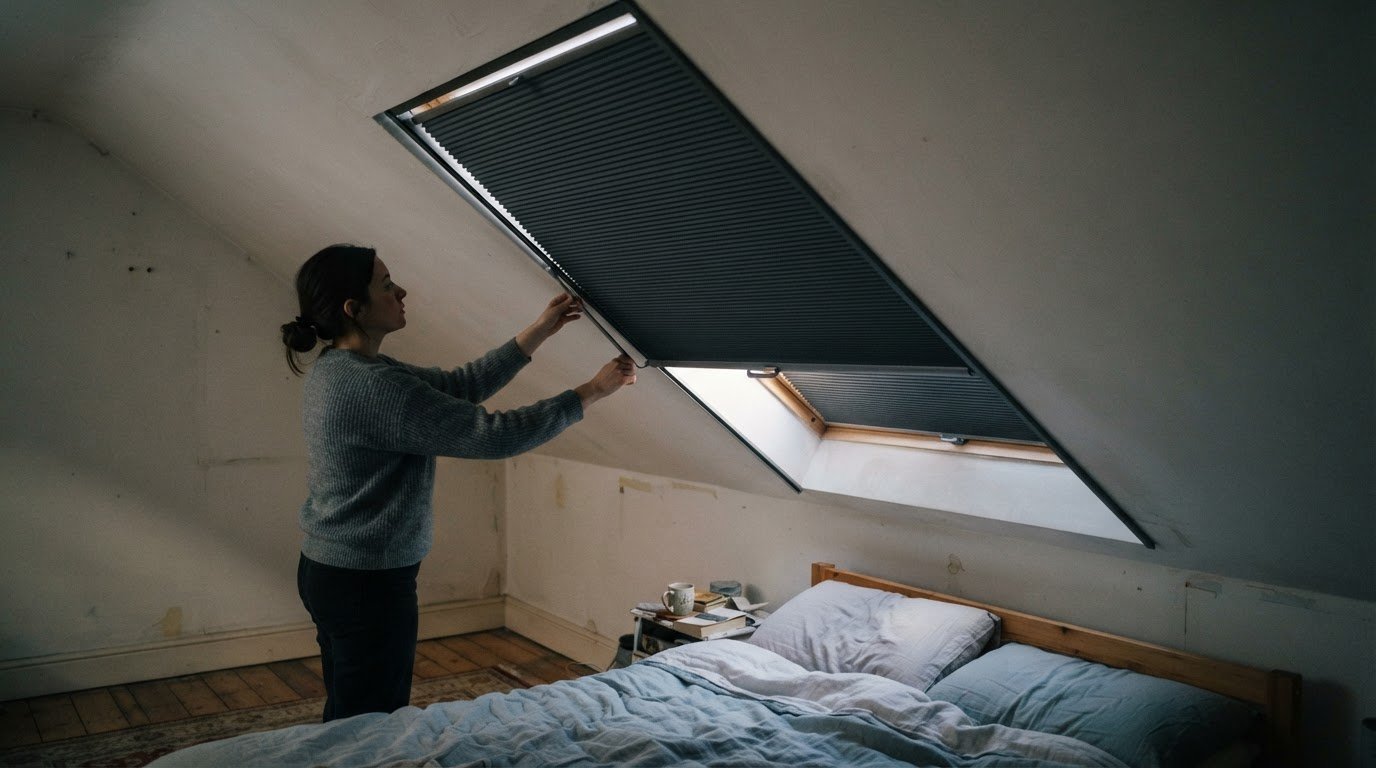
Blackout skylight blinds with side channels can block 99% or more of light, but they won’t make a room completely dark. The fit matters: a close-fitting blind helps limit light around the edges, while the window’s shape affects which options are suitable. That’s why choosing blinds for skylight windows involves more than picking a blackout fabric.
If you’re looking for blinds for skylight windows to darken a bedroom or reduce glare, start by considering how much light you want to block. The fabric, roof-window shape and fit all affect the result.
This guide explains how blackout blinds work, how to choose a made-to-measure option for an angled or flat roof window, and what to consider before fitting. Use the room’s purpose, the window frame and how you’ll operate the blind to guide your choice.
Key Takeaways
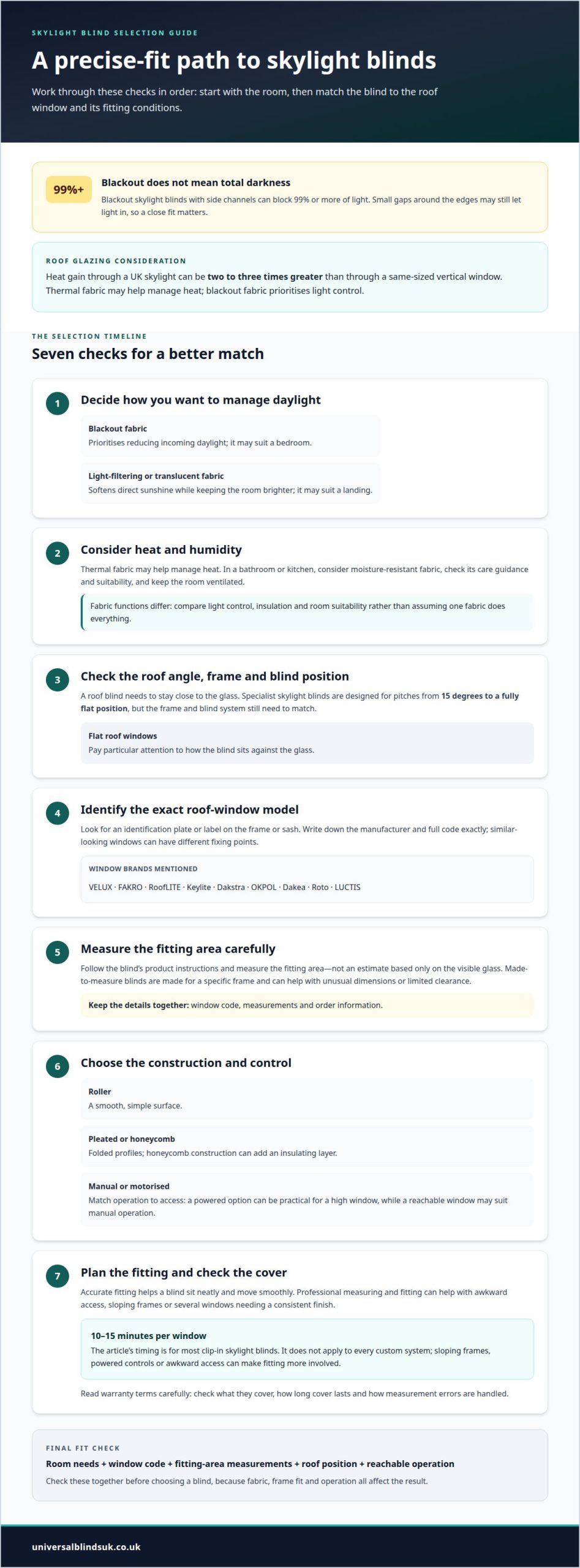
- Choose blackout fabric when limiting light is the priority, and consider light-filtering fabric when you want daylight without direct glare.
- Match a made-to-measure blind to your roof window’s dimensions and opening style for a neater fit.
- Check how your roof’s angle affects the blind’s position against the glass, especially on flat roof windows.
- Accurate measuring and careful fitting help the blind operate smoothly; understand the key installation steps before deciding whether to use a professional fitting service.
Are blackout skylight blinds completely dark?
No. High-quality blackout skylight blinds with side channels are stated to block 99% or more of light, but small gaps can still let light in. For example, light may show around the edges if the blind doesn’t sit closely against the frame. A precise fit helps limit these gaps, though “blackout” doesn’t necessarily mean the room will be completely dark.
Blackout and light-filtering fabrics suit different needs. Choose blackout fabric to reduce incoming daylight, for example in a bedroom. Light-filtering or translucent fabric softens direct sunshine while keeping the room brighter. Think about how you use the space: a bedroom may benefit from blackout, while a landing may suit a lighter option.
Thermal fabrics are another consideration for roof glazing. Heat gain through a UK skylight can be two to three times greater than through a same-sized vertical window. Thermal fabric may help manage heat, while blackout fabric prioritises light control. Compare these functions rather than assuming one fabric does everything.
Overheating and condensation can both be concerns around skylights. Roof glazing can admit strong sunlight and heat, while condensation forms when moist indoor air meets a cooler surface. Keep the room ventilated and consider how the blind sits against the glass, particularly in a bathroom or kitchen.
Moisture-resistant fabrics can be useful in rooms where humidity is part of everyday life. Check the fabric’s care guidance and suitability for the room before choosing. For a RoofLITE window, note the brand and identification details so the blind’s size and fitting method suit the frame.
Blackout roof skylight blinds may use manual or motorised controls. A powered option can be practical when a window sits high above a stairwell, while a reachable window may suit manual operation. Match the control to access, then consider fabric, frame fit and fitting requirements together.
Made-to-measure skylight blinds
Made-to-measure blinds for skylight windows are made for a specific frame, rather than chosen by approximate size. This can help with unusual dimensions or limited clearance. A closer fit can reduce side gaps and support smooth operation. Fabric also affects light control and insulation, so consider how you use the room before deciding.
Compatibility depends on the manufacturer, model and dimensions. Roof-window brands include VELUX, FAKRO, RoofLITE, Keylite, Dakstra, OKPOL, Dakea, Roto and LUCTIS. Similar-looking frames may have different fixing points. Start by identifying the window, rather than matching a blind to the visible glass size alone.
Look for an identification plate or label on the frame or sash. Record the brand and code exactly, then measure the fitting area according to the blind’s instructions. For example, a Keylite window needs measurements taken for its frame, not estimates based on the pane. If you’re considering an electric blind, think about how you’ll reach or operate its control after installation.
- Write down the manufacturer and full window code.
- Measure the fitting area carefully, following the product instructions.
- Choose fabric and operation to suit the room, such as blackout fabric for a bedroom.
Professional measuring and fitting can help with awkward access, sloping frames or several windows that need a consistent finish. Read any warranty terms carefully: check what they cover, how long cover lasts and how measurement errors are handled. Keep the window code, measurements and order details together for reference.
Are made-to-measure skylight blinds worth the extra cost? They can be worthwhile when a window needs a precise fit or has unusual dimensions. The price depends on factors such as window size, fabric, control type and fitting requirements. Get a quote before ordering.
Specialist blinds for angled and flat roof windows
Roof windows need blinds designed for their position, not just their shape. Check the roof pitch, window frame and blind operation together before choosing a style.
Suitability for Angled and Flat Roofs
Skylights, sloping roof windows and flat roof windows each present different fitting conditions. A blind must stay close to the glass rather than hang away from it. Specialist skylight blinds are designed for pitches from 15 degrees to a fully flat position. That range helps you narrow options, but the frame and blind system still need to match.
Compatibility also depends on the roof-window brand and model. Options are available for VELUX, FAKRO, RoofLITE, Keylite, Dakstra, OKPOL, Dakea, Roto and LUCTIS windows. A VELUX blind may not fit a Keylite frame, even if their visible dimensions seem similar. Match the blind to the window identification details, then check its fixing points and operation.
Fabric structure affects the finish. Roller blinds provide a smooth, simple surface, while pleated and honeycomb fabrics create folded profiles. Honeycomb construction can add an insulating layer, while pleated fabric has a compact appearance. Compare how each style sits against the glass and whether its control remains reachable after fitting.
Roman Blinds for Roof Windows
Roman blinds gather into soft horizontal folds as they rise, creating a tailored finish on conventional vertical windows. On angled or overhead glazing, gravity can pull the fabric away from the window unless the system holds it in place. For a roof window, look for a Roman design made specifically for that orientation.
Before choosing Roman blinds, consider how the folds will stack, how much glass they may cover when raised, and whether the control suits the window’s position. Compare their operation with roller or pleated designs. The right choice depends on the frame, roof angle and finish you want, not just the fabric style.
Fitting skylight blinds
Accurate fitting helps roof blinds sit neatly and move smoothly. Most clip-in skylight blinds can be installed in 10-15 minutes per window. That timing applies to clip-in designs, not every custom system. A sloping frame, powered controls or awkward access can make installation more involved.
Before starting, read the instructions for the specific blind and window. Check that the package matches the window code, then lay out the fittings. Keep the sash stable and avoid leaning across an opening. For a high skylight above a stairwell, professional fitting can help avoid reaching into difficult positions.
- Confirm the blind matches the window model and fitting points.
- Position its brackets or clips as the instructions show.
- Secure the blind without forcing parts against the frame.
- Test its movement, then check that it sits evenly.
After fitting, open and close the blind through its full travel. Look for catching fabric, loose clips or uneven edges. Test blackout blinds in daylight, when sunlight makes gaps easier to spot. If the fabric pulls away or the mechanism sticks, stop and review the installation steps before using it again.
Powered roof blinds offer another way to operate a blind. For a remote-operated model, check that the control is accessible from the room. Solar-powered electric blinds are listed in colours including white, cream, brown, light grey, sky blue, blue, Shiraz and black. Consider how the colour looks against the frame and room finish before fitting.
Professional fitting can be useful when the window is hard to reach, the frame is unusual or several blinds need alignment. A fitted blind should move freely and sit securely, without obstructing the window’s normal operation. If you want help with measuring and installation, explore professional blind fitting for your skylight.
Universal Blinds UK: Made-to-Measure Blinds
Universal Blinds UK helps you choose made-to-measure blinds for skylight windows where dimensions and a neat fit matter. Its free measuring service helps establish the measurements, and professional fitting supports a considered installation. Free home consultations and free quotes are available, with no obligation to order.
Turn to Universal Blinds UK if you want help choosing blinds for a particular room, such as blackout fabric for a bedroom or a lighter finish elsewhere. The measuring and fitting services also offer practical support when a roof window is awkward to reach or its frame needs careful attention. Custom shutters are another made-to-measure option for other windows in your home.
To discuss made-to-measure blinds and fitting for your home, contact Universal Blinds UK or visit universalblindsuk.co.uk.
Make your next step a considered one
Think about how you want the room to work throughout the day. A bedroom used for daytime rest may call for a different balance of light and privacy than a bright landing or home office. Let the room’s everyday purpose guide your choice, rather than focusing on appearance alone.
Before deciding, picture the blind in place: how it will look against the frame, how you’ll operate it, and whether it suits the room’s use. The best blinds for skylight windows fit your priorities and feel practical in daily life.
Universal Blinds UK can help you consider suitable options for your home. If you’re ready to explore the next step, get in touch with Universal Blinds UK and discuss what would work for your space.
Frequently Asked Questions
Are skylight blinds difficult to install?
Not necessarily. Fitting depends on access, frame design and the blind mechanism. A low, easily reached roof window with matching fixings is simpler to work on than a high window above a stairwell. Before starting, clear the work area, protect nearby furniture and follow the instructions for that exact model. Professional fitting can help when safe access or precise alignment is a concern.
Can skylight blinds be integrated with smart home systems?
Only if the blind’s motor and the smart-home system are designed to work together. A remote control does not automatically mean the blind connects to a home hub or voice assistant. Before choosing an automated system, identify the control method you need and check that its components are compatible. If you want simple operation without integration, a standard manual control avoids adding connected equipment.
Do Skylight Blinds Keep Heat In?
Some blinds can help reduce heat movement through a roof window, but they do not replace the window’s insulation. The result depends on the fabric, how closely the blind fits and gaps around its edges. A loose-fitting blind, for example, may provide less insulation than one that sits neatly within the frame. Consider ventilation too, especially in rooms prone to condensation.
Do you offer a warranty on skylight blinds?
Warranty cover depends on the written terms for the product and fitting; there is no single term for every skylight blind. Read the terms before ordering and check what they cover, how long cover lasts and how to report a fault. See whether fabric, operating parts and fitting are treated separately, as their cover may differ.
What types of skylight blinds are available?
Common styles include roller, pleated, honeycomb and Roman blinds, with blackout or light-filtering fabric choices. Manual and powered controls are also available in the wider market. Compare how each design works in your room: roller styles give a streamlined finish, while folded fabrics create a more textured appearance. The frame and roof angle affect which systems suit the window.
What types of blinds are suitable for skylight windows?
Choose a blind designed for roof-window installation, then match its fittings to the window’s manufacturer, model and shape. A blind made for a VELUX frame, for instance, may not fit a different brand. Consider the room’s purpose, the light level you want and how easily you can reach the controls. Made-to-measure blinds can be tailored to the window’s dimensions.