

Local Craftsmanship Window Shutters: The Definitive British Homeowner Guide (2026)
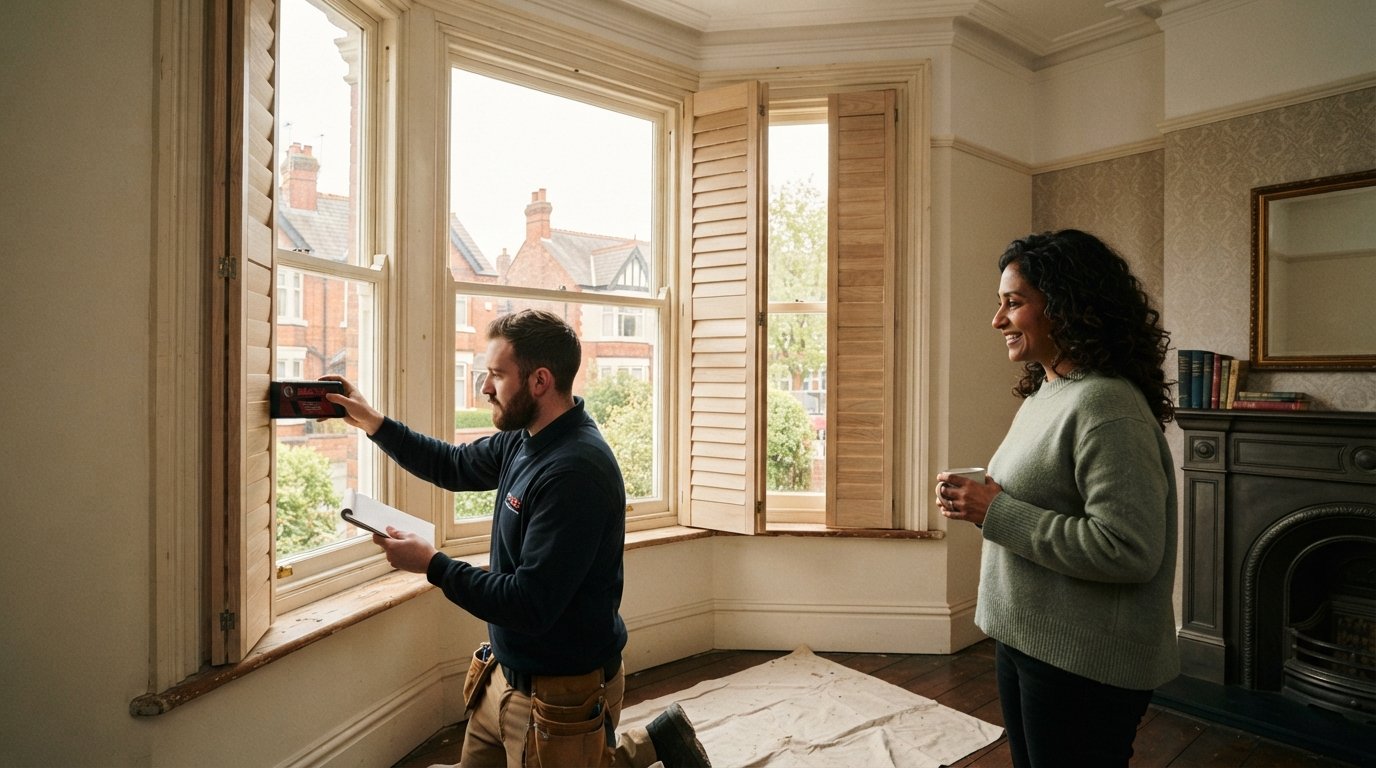
There is no such thing as a truly square window reveal in a British home. From sloping Victorian sashes to settle-cracked bay windows, our distinctive architectural heritage simply doesn’t cooperate with off-the-shelf measurements. That is why choosing local craftsmanship window shutters has become essential for homeowners who demand tailored elegance rather than awkward, ill-fitting compromises.
If you’re wary of aggressive nationwide sales pitches or worried about panels arriving with incorrect dimensions for out-of-plumb reveals, your concerns are completely justified. Distinguishing resilient, authentic timber from cheap, heavy MDF shouldn’t feel like hard work, nor should accounting for complex picture rails or ornate architraves. In this guide, you’ll discover how bespoke local surveying and joinery deliver a durable fit tailored precisely to your property’s historic quirks and period frames.
We’ll walk you through the key craftsmanship standards to evaluate, the differences between core materials, and how an expert, zero-pressure technical survey guarantees complete peace of mind from start to finish.
Key Takeaways
- Discover why investing in local craftsmanship window shutters treats your windows as an enduring architectural feature, preventing the alignment failures typical of mass-produced alternatives.
- Learn the essential joinery and material benchmarks that prevent seasonal timber warping, frame binding, and louvre stiffness over years of daily use.
- Understand how bespoke custom framing seamlessly accommodates out-of-square reveals, sloping sills, and intricate splay bay mouldings.
- See how an in-depth technical survey and precision laser measuring safeguard against costly fitting errors before a single component is built.
- Recognise the lasting value of working with accountable, community-rooted specialists who provide pressure-free guidance from consultation to final installation.
What Defines True Local Craftsmanship in Window Shutters?
True craftsmanship treats a shutter as an architectural fixture rather than mere decorative cladding. British homes possess distinct structural personalities, from settling Victorian lintels to draughty Edwardian bays. Off-the-shelf, mass-manufactured panels simply cannot adapt to these irregular spaces without awkward filler strips and unsightly gaps. Investing in local craftsmanship window shutters ensures your installation works with the building’s natural geometry, creating a seamless boundary that enhances both light control and thermal insulation.
A regional specialist prioritises long-term structural stability over rapid factory turnaround. As highlighted in this detailed window shutter overview, the distinction between decorative louvres and functional joinery rests on timber selection, precise mortise tolerances, and purposeful framing. To see how foundational shutter components are constructed from raw materials, take a look at this practical demonstration:
Bespoke Joinery vs. Mass-Manufactured Panels
Mass-market retailers rely on rapid production lines using basic dowels and chemical adhesives. Over time, seasonal humidity shifts cause these glue bonds to fail, leading to panel sag and sticking louvres. Bespoke craftsmanship uses precision mortise-and-tenon joinery, allowing natural wood movement without compromising frame rigidity. Bespoke construction also means top, middle, and bottom rails are scaled to align with your window’s horizontal transoms, preserving balanced architectural sightlines both inside and out.
The Role of Local Expertise in British Homes
National shutter chains often divide responsibility across third-party sales reps, regional surveyors, and subcontracted fitters. When errors occur, accountability vanishes between departments. Choosing local craftsmanship window shutters connects you directly with seasoned fitters who understand local architecture, whether that means managing thick solid-brick reveals or lath-and-plaster returns. Having the same experienced specialist manage your technical survey and final fitting ensures every historic subtlety is accounted for, eliminating the frustrating communication gaps common with national call centres.
Essential Hallmarks of Quality Shutter Construction and Materials
Separating enduring shutter joinery from mass-produced window dressings comes down to raw timber preparation, internal engineering, and surface resilience. While commercial retailers often rely on vague proprietary names to mask heavy composites, authentic construction focuses on verifiable timber stability. Choosing local craftsmanship window shutters gives you access to specialised joinery designed specifically to withstand the rapid temperature swings and damp winters typical of British homes.
Mortise and Tenon Joinery and Engineered Cores
Daily operation exerts substantial rotational strain on shutter frames. Traditional mortise and tenon joints resist these racking forces far better than basic wooden dowels. Premium timber shutters also utilise engineered wood cores, where multiple layers of grain are laminated in opposing directions. This counteracts natural movement, preventing vertical stiles from bowing over wide spans and ensuring panels never bind against their framing beads.
Advanced Finishes and UV Protection
Intense ultraviolet exposure on south-facing window sills quickly breaks down inferior coatings. A high-calibre finish requires a methodical multi-stage application:
- Multiple Sanded Undercoats: Seal the grain and establish a flat, non-porous base.
- Polyurethane Enamel Topcoats: Deliver exceptional chip resistance compared to soft latex paints.
- Integrated UV Inhibitors: Prevent bright whites from yellowing and protect rich stains from bleaching.
Unlike cheap vinyl foils that bubble and peel near central heating radiators, hand-applied spray finishes maintain their silky appearance over decades of direct sunlight.
Louvre Tensioning and Hardware Engineering
Smooth operation relies entirely on the mechanical components tucked away inside the stiles. Cheaper imported panels frequently suffer from loose louvres that drop shut under their own weight after a few months. Premium joinery incorporates concealed tension screws, allowing you to fine-tune louvre resistance with a simple screwdriver. High-grade brass or marine-grade stainless steel hinges are deeply recessed into the stile, keeping sightlines neat and bearing heavy panel loads without drooping.
Exploring authentic timber samples in your own living space is the most reliable way to evaluate these mechanical details firsthand. You can explore bespoke finishing options and material textures through custom shutters fitted specifically to your room’s requirements, helping you select the ideal joinery without any sales pressure.
Solving British Architectural Quirks: Bays, Sashes, and Uneven Reveals
Centuries of structural settlement mean British window reveals are almost never plumb or square. Plaster bows outward, lintels dip over time, and stone sills develop gentle slopes. Standard mass-market installers often force rigid factory frames into these irregular openings, concealing the resulting gaps behind broad caulk beads and unsightly plastic infill strips. Relying on local craftsmanship window shutters avoids this compromise through precise architectural templating that scribes every frame directly to your wall’s true contour.
To explore how varied configurations suit specific room designs, read our detailed guide on elegant window shutters. The difference in execution between mass fabrication and bespoke local joinery is striking:
- Mass-Market Approach: Uses standard rectangular frames, resulting in uneven shadow gaps, bound hinges, and lost window board depth.
- Bespoke Architectural Templating: Adjusts outer frame depths and jamb angles to match sloping reveals, keeping the internal shutter panels perfectly square and operational.
Mastering Bay Windows: Splay, Box, and Multi-Facet
Bay windows present distinct geometric challenges, whether you have a 90-degree box bay or an angled 135-degree splay bay. Bespoke joinery utilises precision-milled corner posts custom-cut to match your bay’s specific angles, rather than forcing generic joiners together. This approach preserves usable window board space, maximises natural daylight, and ensures adequate clearance for window handles, locking stays, and catches without impeding louvre rotation.
Victorian Sash Windows and Deep Period Reveals
Period sash windows demand sympathetic detailing to protect original timber architraves and plaster mouldings. Tier-on-tier shutters work exceptionally well here; their independent top and bottom tiers mirror split-sash proportions, offering street-level privacy while allowing clear daylight from above. By creating a snug internal barrier across deep masonry reveals, custom shutters also drastically cut draughts, adding vital thermal comfort to single-glazed period rooms.
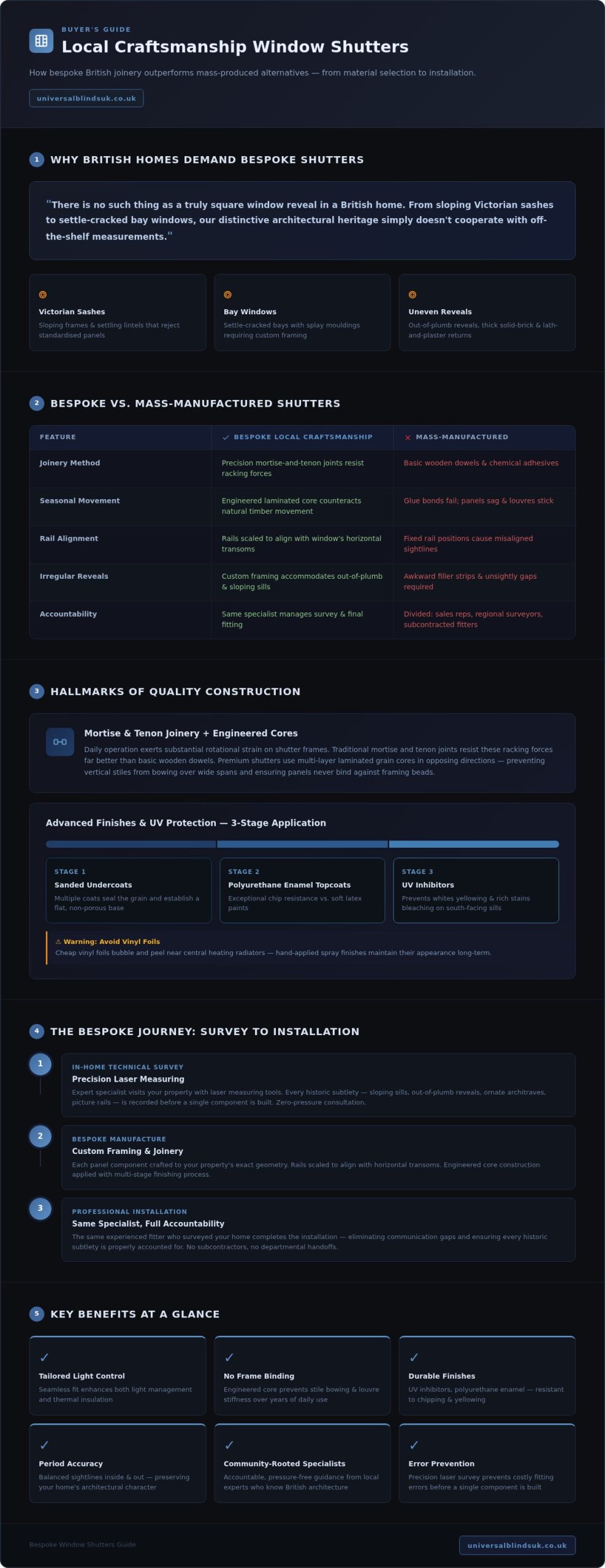
The Bespoke Journey: From In-Home Survey to Professional Installation
Transforming an initial window concept into an enduring architectural feature follows four disciplined steps: in-home consultation, technical survey, precision manufacture, and master fitting. Unlike remote ordering models that rely on homeowner guesswork, investing in local craftsmanship window shutters guarantees that every dimension is verified by trade specialists. You can review our detailed analysis on professional fitting benefits to understand why hands-on assessment prevents expensive structural mistakes.
The Complimentary In-Home Technical Assessment
During the initial survey, an expert assesses your window openings directly rather than relying on rough estimates. This stage evaluates wall composition, whether solid brickwork or delicate lath-and-plaster, alongside handle clearances and rebate depths. Digital laser tools record minute reveal twists that standard tape measures inevitably miss.
Crucially, this visit allows you to examine real timber grain and paint swatches within your home’s natural light. Daylight and warm evening lamps alter paint undertones significantly. In a calm, zero-pressure environment, you can explore louvre widths and frame profiles at your own pace while discussing privacy and light control with a knowledgeable specialist.
Precision Fitting and Acoustic Calibration
Once custom crafting is complete, professional installation turns individual timber components into a unified fixture. Specialists use meticulous scribing techniques, hand-planing frame margins so they sit flush against historic plaster undulations without relying on thick, unsightly caulk lines.
Hinges are aligned with millimetre precision to eliminate panel drop, ensuring smooth closure and balanced weight distribution for years to come. After verifying louvre tension and checking perimeter seals for optimal draught reduction, your fitter conducts a comprehensive operational walkthrough so you’re completely satisfied with every movement.
To take the first step towards bespoke timber styling, schedule your complimentary technical survey with our family-run team today.
Why Discerning West Midlands Homeowners Choose Local Shutter Specialists
A home is both a personal sanctuary and a significant financial investment. Across communities in Walsall, Sutton Coldfield, Solihull, and Wolverhampton, choosing local craftsmanship window shutters means investing in community-rooted accountability. National firms often treat domestic window installations as transactional volume, but local independent specialists thrive on personal referrals and long-standing regional trust. Bespoke timber shutters also provide an insulating thermal barrier that can reduce window heat loss by up to 28%, significantly boosting kerb appeal while lowering heating demands during cold British winters. You can learn more about our dedicated regional presence via our guide to local blinds experts in the West Midlands.
The Value of Dedicated Regional Accountability
National shutter suppliers frequently rely on disconnected sub-contractor networks. When an adjustment is needed months down the line, reaching the person who actually fitted your shutters can prove frustratingly difficult through centralised call centres. In contrast, working with a family-run specialist guarantees a direct relationship with seasoned tradespeople who take personal pride in their work. You receive transparent advice based on your home’s layout rather than an aggressive script pushed by commission-led sales reps, ensuring total peace of mind for the lifetime of your shutters.
Taking the Next Step Towards Bespoke Shutters
Beginning your shutter journey shouldn’t involve high-pressure tactics or immediate commitments. An initial design consultation should always be complimentary and pressure-free, giving you space to evaluate real timber samples, explore finishes, and discuss louvre widths at your own pace.
Before your specialist arrives, it helps to consider how you use each living space throughout the day. Consider whether you prioritise street-level privacy, morning light diffusion, or room-darkening performance for bedrooms. With clear preferences and supportive guidance from the Universal Blinds UK team, transforming your windows becomes an inspiring, straightforward experience from the initial survey to the final operational check.
Bring Enduring Precision to Your Living Spaces
Your windows do far more than let in daylight; they define the architectural character and comfort of your home. Opting for mass-market alternatives often leads to frustrating compromises, particularly across settling period sashes and angled bay reveals. Investing in local craftsmanship window shutters ensures your timber joinery moves in harmony with your building’s natural contours, maintaining crisp panel alignment and eliminating cold draughts for years to come.
As a family-run business based in Walsall, Universal Blinds UK is dedicated to providing transparent guidance and master-grade installation across the West Midlands. You’ll never face aggressive sales pitches or subcontracted shortcuts; just dependable advice from specialists who care about local homes. Book your free, no-obligation home consultation today to inspect authentic timber finishes under your own room lighting, and discover the lasting comfort of truly bespoke joinery.
Frequently Asked Questions
How long do locally crafted custom shutters typically take from survey to fitting?
Production and installation timelines typically range from several weeks up to around ten to twelve weeks depending on timber sourcing and specifications. UK-crafted custom options can sometimes be ready in as little as two to four weeks. Because every shutter is precision-engineered to your unique window profile, the process prioritises an enduring architectural fit over rushed assembly. Your local specialist provides clear, honest scheduling updates at every stage.
Can custom window shutters be fitted to uneven or out-of-square period windows?
Yes, bespoke custom shutters are specifically designed to overcome irregular, out-of-square British window reveals. Rather than using rigid generic frames, local craftsmanship window shutters rely on custom framing profiles that can be planed and scribed directly to sloping lintels or uneven brickwork. This tailored approach keeps internal shutter panels perfectly square and hanging plumb, ensuring effortless louvre adjustment without binding or unsightly light gaps.
What is the main functional difference between wooden shutters and MDF alternatives?
The primary functional differences lie in weight, longevity, and natural structural stability. Solid timber joinery is significantly lighter than dense MDF composites, placing much less strain on frame hinges over wide window spans. While MDF can swell if exposed to excessive moisture or edge damage, authentic hardwood maintains its shape through seasonal humidity shifts and can be easily refinished or repainted over decades of daily use.
Do made-to-measure window shutters help insulate homes against heat loss and noise?
Yes, professionally fitted timber shutters form an effective thermal barrier against single-glazed glass and draughty frames. By trapping an insulating air pocket between the shutter panel and the window pane, closed louvres can reduce window heat loss by up to 28%. The solid timber structure also dampens external street noise, creating a quieter, far more comfortable indoor environment throughout chilly British winters.
Why is a professional in-home survey essential before ordering custom shutters?
An in-home survey ensures your shutters account for structural quirks that simple tape measurements miss entirely. Specialists use precision laser tools to check reveal depths, window handle clearances, and plaster settlement. Choosing local craftsmanship window shutters begins with this complimentary visit, giving you the chance to assess authentic wood samples alongside your room decor while receiving honest technical guidance in a relaxed, zero-pressure atmosphere.
Can bespoke shutters be fitted to complex bay windows without losing sill space?
Tailored bay window shutters utilise custom corner posts engineered to mirror the exact splay or 90-degree angles of your window architecture. By mounting the framework as close to the window frames as clearances permit, specialist installers retain maximum window board depth. This precise configuration preserves practical sill space for decorative displays while allowing easy access to locking latches and window handles.
How do I care for and maintain handcrafted timber shutters to ensure longevity?
Handcrafted timber shutters require minimal ongoing maintenance to preserve their lustrous finish. Regular dusting with an ostrich-feather duster or a dry microfibre cloth across both sides of the tilted louvres keeps surfaces pristine. For occasional cleaning, wipe the woodwork with a slightly damp cloth and dry immediately. Never use harsh chemical abrasives, and periodically check internal tension screws to maintain smooth louvre movement.