

Blinds vs Shutters: Which is Best for Your West Midlands Home in 2026?

Did you know that your windows could be responsible for nearly a third of your home’s heat loss during a biting West Midlands winter? You likely already know that the right window treatment can transform a room, but choosing between blinds vs shutters often feels like a trade-off between immediate style and long-term performance. Whether you’re dealing with the drafty frames of a heritage property in Walsall or seeking sanctuary from the prying eyes of a busy Birmingham street, you want a solution that feels tailored to your home and your lifestyle.
We understand that making this choice is a significant decision for your comfort and kerb appeal. This guide will help you understand the 2026 landscape of window coverings, comparing everything from the latest energy efficiency standards to long-term maintenance. We’ll explore how bespoke shutters act as a permanent architectural upgrade and how modern, made-to-measure blinds offer versatile light control, ensuring you find the perfect professional finish for your windows.
Key Takeaways
- Compare the long-term investment value of blinds vs shutters to see which suits your budget and aesthetic goals for 2026.
- Discover which window treatments offer the best thermal insulation to help lower your energy bills during cold British winters.
- Learn how to achieve total privacy in busy urban areas like Birmingham without sacrificing natural light.
- Explore why moisture-resistant materials are a non-negotiable choice for kitchens and bathrooms in heritage homes.
- Find out how a professional measuring service ensures a perfect fit for the unique architectural quirks of West Midlands properties.
Blinds vs Shutters: Understanding the Core Differences
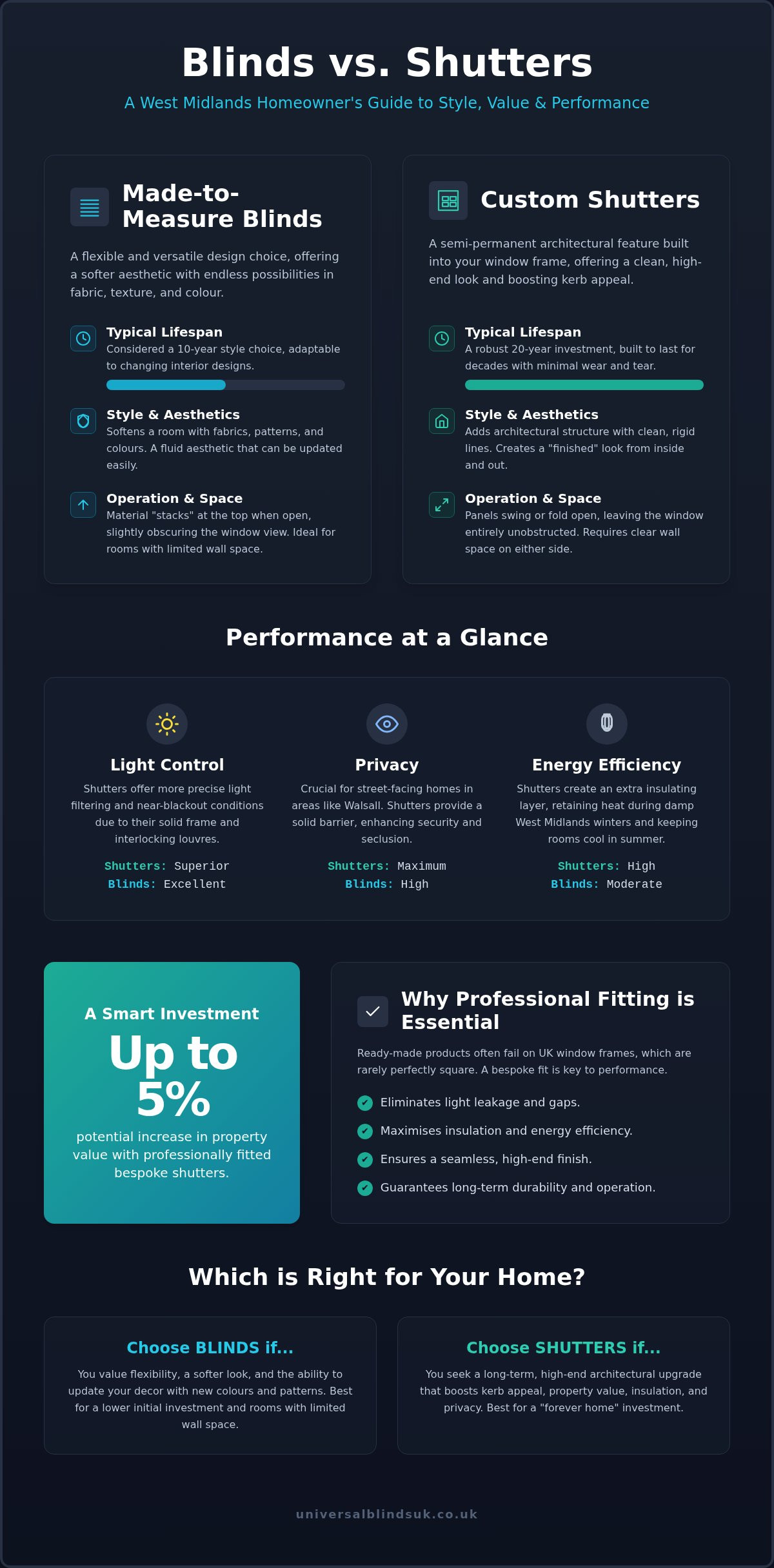
Choosing between blinds vs shutters is more than just a style preference; it’s about how you interact with your home’s architecture. While both serve to control light and heat, they function in fundamentally different ways. Blinds offer a lightweight, flexible solution that can be changed easily as your decor evolves. Shutters, on the other hand, are considered a permanent addition to the property. They often stay with the house for decades, acting more like a piece of furniture than a simple window dressing. It’s a structural upgrade that changes the very feel of a room.
To help you visualize these differences, it’s useful to look at a comprehensive guide to window coverings to see how these categories overlap and differ in function. In the West Midlands, where we see a mix of Victorian terraces and modern developments, the right choice often depends on whether you want a subtle, minimalist finish or a bold architectural feature that defines the window. Your decision will impact everything from your daily privacy to your home’s thermal performance during the British winter.
To better understand this concept, watch this helpful video:
Structure and Fitting: Fixed vs Flexible
Installation is where the two options diverge most sharply. Custom shutters are built into a dedicated frame that is fixed directly to your window casing or the surrounding wall. This makes them a part of the room’s permanent architecture. Blinds are typically installed using top-mount or face-mount brackets, allowing the fabric or slats to hang freely. This flexibility is ideal if you enjoy refreshing your interior design every few years. However, both require professional measuring to ensure they sit flush. This is especially true in older homes in areas like Walsall, where window frames are rarely perfectly square. A bespoke fit eliminates the unsightly gaps that let in drafts and light.
Cost Comparison: Budgeting for 2026
When looking at your budget for 2026, you should weigh the initial price against long-term value. Made-to-measure blinds are generally more accessible, offering a high-quality finish at a lower entry point. Shutters require a larger initial investment because of the premium materials and the complexity of the installation. However, shutters are often viewed as a “capital improvement” by UK estate agents, potentially increasing the resale value of your Birmingham property. While DIY kits might look tempting online, they rarely account for the precision needed for a professional finish. Investing in a bespoke service means you won’t be paying for replacements or repairs just a few years down the line. Shutters are built to last fifteen to twenty years, whereas blinds may need updating after seven, making shutters a very cost-effective choice over time.
Light Control and Privacy: Finding the Perfect Balance
Managing natural light while keeping prying eyes at bay is a delicate dance, especially in densely populated areas like Birmingham or Walsall. When comparing blinds vs shutters, the primary difference lies in the level of granular control you have over your environment. Venetian blinds and plantation shutters both use horizontal slats, but the scale and operation differ. Shutters offer wider louvres that provide a cleaner view out when open, while blinds have thinner slats that can create a more textured light effect. This choice determines how much you see of the outside world and how much it sees of you.
Blackout performance is a common concern for bedrooms. Many homeowners worry about light leakage at the edges of their window treatments. While shutters are excellent at darkening a room, they do have small gaps where the panels meet the frame. If you need total darkness for a shift-working schedule, bespoke roller blinds with side channels often provide a tighter seal. However, for most people, the solid structure of a shutter is more than sufficient to dim a room significantly. It’s about finding the specific balance that helps you sleep better.
Privacy for Overlooked Properties
If your living room opens directly onto a busy pavement, cafe style shutters are an elegant solution. They cover only the bottom half of the window, allowing light to flood in from the top while keeping your home private. For a more modern aesthetic, top-down bottom-up blinds offer similar flexibility. You can position the shade exactly where the sun hits or where passers-by might look in. Achieving this level of precision relies on expert fitting. A professional measuring service ensures your window treatment sits perfectly within the recess, eliminating the light gaps that often plague DIY installations. If you’re unsure which style fits your window’s unique shape, you can book a free home consultation to see samples in your own light.
UV Protection and Furniture Care
South-facing rooms in the West Midlands can suffer from intense UV exposure, leading to faded carpets and damaged upholstery. While adjustable slats allow you to bounce light off the ceiling, some homeowners also look to professional window film services like Sun Guard Tint to provide an extra layer of UV protection that complements their blinds or shutters. Directional light control is the strategic tilting of slats to redirect natural light towards the walls, illuminating the space while preventing direct glare and protecting your privacy. This is particularly useful during rare UK heatwaves, helping manage passive solar gain and keeping your interiors cooler.
- Precision: Shutters offer robust, fixed louvres for long-term stability.
- Versatility: Blinds can be fully retracted to give you an unobstructed view.
- Security: The solid presence of shutters can act as a visual deterrent.
Energy Efficiency and Maintenance: Managing the UK Climate
Your windows are the primary point of heat exchange in your home. During a typical British winter, an unprotected window can feel like a permanent draft source, especially in the older heritage properties found across Walsall and Birmingham. When weighing up blinds vs shutters, you aren’t just choosing a look; you’re choosing how well your home retains expensive warmth. Research from the University of Salford’s Energy House Labs shows that internal plantation shutters can reduce heat loss through double glazing by up to 28%. This is achieved by creating a sealed air pocket between the glass and the solid shutter panel, acting as a secondary layer of insulation.
High-performance blinds can be equally effective. A honeycomb blackout blind installed in a framed system can actually outperform shutters, reducing heat loss by up to 32%. Even a standard roller blind with side channels can offer a 22% reduction. The key to these figures is the precision of the fit. Gaps at the edges of a window treatment allow “thermal bypass,” where warm air escapes and cold air enters. This is why professional measuring is vital. It ensures the treatment sits flush against the frame, effectively trapping heat where it belongs.
Thermal Retention and Heat Loss
Professional fitting can reduce overall room heat loss by 15-20% simply by eliminating drafts that DIY kits often miss. While wooden shutters have a naturally low U-value, meaning they are excellent at resisting heat flow, modern thermal-lined blinds are specifically engineered to reflect heat back into the room. If you’re looking for a deep dive into the structural benefits of solid window treatments, you might find A Homeowner’s Guide to Elegant Window Shutters helpful for understanding how these fixtures integrate with your home’s thermal envelope.
Maintenance and Longevity
The West Midlands climate can be damp, which often leads to condensation on window panes. In these conditions, moisture-resistant materials are essential. Faux-wood shutters and aluminium Venetian blinds are ideal because they won’t warp or develop mould when exposed to window moisture. Maintenance is another clear point of difference. Shutters are remarkably easy to keep clean; a quick wipe of the wide slats with a damp cloth is usually enough. This makes them a superior choice for hayfever and allergy sufferers, as they don’t trap pollen and dust in the same way that soft fabric blinds can. In a busy family home with pets and children, the robust nature of a shutter panel often proves more durable than the delicate cords and fabrics of a standard blind.
Room-by-Room Guide: Choosing for West Midlands Architecture
Every room in your home serves a different purpose, and the architectural quirks of West Midlands properties often dictate which window treatment will perform best. From the sprawling bay windows of Edgbaston to the compact, modern apartments in Walsall, the blinds vs shutters debate is best settled by looking at the specific needs of each space. You aren’t just choosing a decoration; you’re selecting a functional tool that manages light, heat, and privacy based on the room’s daily use.
In the living room, you’re likely looking for a balance between a cosy evening atmosphere and precise daytime light control. Shutters offer a sophisticated, furniture-like finish that complements traditional fireplaces and high ceilings. If you prefer a softer, more minimalist look, layering made-to-measure blinds can add texture without dominating the room’s footprint. Once your windows are beautifully dressed, you might want to visit First4Frames Gallery to find the perfect bespoke framing for your art collection. For kitchens and bathrooms, high-humidity zones require moisture-resistant materials. Faux-wood is the gold standard here. Unlike real wood, it won’t warp or peel when exposed to steam from a hot shower or a boiling kettle. Both faux-wood shutters and aluminium Venetian blinds are excellent choices for longevity in these damp environments.
Bedrooms require a focus on sleep quality. For those seeking a total blackout, bespoke roller blinds with side channels are incredibly effective at sealing out streetlights. However, the heavy-duty nature of shutters also provides excellent light exclusion and an added layer of noise reduction. This is a major benefit if your home is situated near a busy Birmingham commuter route or a noisy town centre.
Tackling the Traditional UK Bay Window
Victorian and Edwardian terraces are a hallmark of our local architecture, but their three-part or five-part bay windows are notoriously difficult to dress. Standard, off-the-shelf blinds often leave unsightly gaps at the angles, which compromises your privacy and lets in annoying slivers of light. This is where the seamless elegance of shutters shines. They’re custom-built to follow the exact curve or angle of your bay, creating a clean, architectural look that enhances your home’s kerb appeal. If you’re considering other options for these tricky spaces, A Complete Guide to Blind Styles: Find the Perfect Match for Your Home offers a breakdown of how different designs handle heritage window shapes.
Home Offices and Conservatories
With more of us working from home, reducing screen glare has become a priority. Adjustable Venetian or Vertical blinds allow you to pivot the light away from your monitor without plunging the room into darkness. In glass-heavy conservatories, temperature regulation is the biggest challenge. Thermal-lined blinds help keep the space usable year-round, preventing it from becoming a greenhouse in summer or an icebox in winter. Additionally, the structured look of plantation shutters provides a professional, “office-ready” background for your video calls.
Ready to see how these styles look in your own space? You can book a free home measuring appointment today and let our specialists guide you through the best options for your specific window types.
The Bespoke Advantage: Why Professional Fitting Matters in 2026
You’ve spent time weighing up the aesthetic and thermal benefits of blinds vs shutters, but the success of either choice hinges on the final millimetre of the fit. In 2026, as home energy efficiency becomes even more critical, a gap-free installation isn’t just about looks; it’s about performance. While national chains might offer a fast-track service, they often lack the nuanced understanding of the West Midlands’ diverse housing stock. Our journey at Universal Blinds UK is designed to be entirely stress-free, starting with a no-obligation home consultation where we bring the showroom to your doorstep.
We often hear the phrase “measure twice, cut once,” but for the older properties in our region, even that isn’t enough. Many heritage homes have shifted over the decades, resulting in uneven lintels and frames that are far from square. A professional installer doesn’t just measure the width; they assess the structural integrity and the specific clearance needed for a seamless operation. You can learn more about The Benefits of Professional Blind Fitting: Why DIY Can’t Compare to see why expert intervention is the safest route for your investment.
The True Cost of DIY Measuring Mistakes
Attempting a DIY installation on a “wonky” Victorian window often leads to costly errors. If a shutter frame is even slightly misaligned, the louvres won’t tilt correctly, and the panels may catch. Similarly, a blind that is a fraction too wide will scrape the recess, leading to premature wear. By seeing physical samples in your own room’s light during our visit, you can be certain of the colour and texture before any manufacturing begins. This eliminates the “online lottery” of ordering based on a screen image, providing peace of mind backed by local guarantees and professional aftercare that national websites simply can’t match.
Your Local West Midlands Experts
As a family-run business with deep roots in Walsall, Birmingham, and Solihull, we take personal pride in every window we dress. We aren’t just another faceless entity; we are Your Local Blinds Experts: The Smarter Choice for Blinds Near You in the West Midlands. Our heritage-led approach means we value reputation over a quick sale. We promise a no-pressure environment where our specialists guide you toward the right bespoke choice for your home’s unique character. From the initial technical assessment to the final implementation, you’re supported by experts who live and work in your community.
Transform Your West Midlands Windows for 2026
Deciding between blinds vs shutters ultimately comes down to your long-term goals for your home’s comfort and style. Whether you choose the permanent architectural elegance of shutters or the versatile, modern finish of bespoke blinds, you’re making a significant investment in your property’s value. We’ve seen how the right window treatment can slash heat loss by up to 32% while providing the essential privacy needed in busy urban areas like Birmingham or Walsall. Both options offer a sophisticated way to manage the unpredictable British climate while enhancing your room’s aesthetic.
Don’t leave the final result to chance with risky DIY measurements. Our local, family-run team is here to ensure a flawless, professional finish that respects the unique character of your property. We provide free no-obligation measuring and quotes, bringing high-quality bespoke materials directly to your door so you can see them in your own light. It’s time to give your windows the expert attention they deserve.
Book your free in-home consultation with our West Midlands experts today and take the first step toward a more beautiful, energy-efficient home. We look forward to helping you make the perfect choice for your space.
Frequently Asked Questions
Are shutters more expensive than blinds?
Yes, shutters typically require a higher initial investment than blinds because of the premium materials and the complexity of the custom-built frame. While made-to-measure blinds are a more budget-friendly way to refresh your room’s aesthetic, shutters are considered a long-term architectural addition. They often pay for themselves over decades through their superior durability and the energy savings they provide for your home.
Do shutters provide better insulation than blinds?
Custom shutters are excellent at trapping heat, but certain high-performance blinds can offer even better thermal retention for your windows. While shutters create a solid insulating air pocket, honeycomb or cellular blinds are specifically engineered with cells to block heat transfer. Both options significantly outperform standard curtains, helping you maintain a comfortable temperature in your West Midlands home throughout the cold winter months.
Which is easier to clean: blinds or shutters?
Shutters are generally much easier to maintain than most fabric blinds. Their wide, solid louvres can be wiped down quickly with a damp cloth, making them ideal for high-traffic areas or homes with pets. In contrast, fabric blinds can trap dust and pollen, often requiring more delicate cleaning or professional care to keep them looking their best over a long period.
Can I install shutters on a bay window?
Bay windows are one of the most popular places to install custom shutters because of their bespoke nature. The shutter frames are designed to follow the exact angles of your bay, providing a seamless look that standard blinds often struggle to achieve. This eliminates the awkward light gaps frequently found in traditional Victorian or Edwardian three-part windows common across the West Midlands.
Do shutters add more value to my home than blinds?
Shutters are often viewed as a permanent fixture by estate agents and can increase the resale value of your property. Unlike blinds, which are usually removed by the seller, shutters stay with the house as a capital improvement. This makes them a highly attractive feature for potential buyers in the competitive Birmingham and Walsall property markets, where kerb appeal is a major factor.
Are blinds or shutters better for privacy?
When weighing up blinds vs shutters for privacy, shutters often provide a more robust solution for ground-floor rooms. Cafe-style shutters allow you to cover the bottom half of a window while letting light in at the top. However, top-down bottom-up blinds offer similar flexibility for modern homes, ensuring you aren’t overlooked by neighbours while still enjoying natural brightness in your living space.
How long do made-to-measure shutters typically last?
High-quality made-to-measure shutters are designed to last for 15 to 20 years or even longer with basic maintenance. They are much more durable than standard blinds, which may need replacing every 4 to 7 years as fabrics fade or mechanical cords wear out. This impressive longevity makes shutters a more sustainable and cost-effective choice for many West Midlands homeowners looking for a permanent solution.
Can I have both blinds and curtains on the same window?
You can certainly layer blinds with curtains to achieve a softer, more traditional look in your home. This combination is excellent for improving light control and adding an extra layer of insulation against winter drafts. While shutters are typically designed to stand alone as a primary architectural feature, blinds are often paired with drapery to create depth and texture in bedrooms.