
The Hidden Risk of Measuring for Blinds Myself: Why DIY Accuracy is Harder Than It Looks
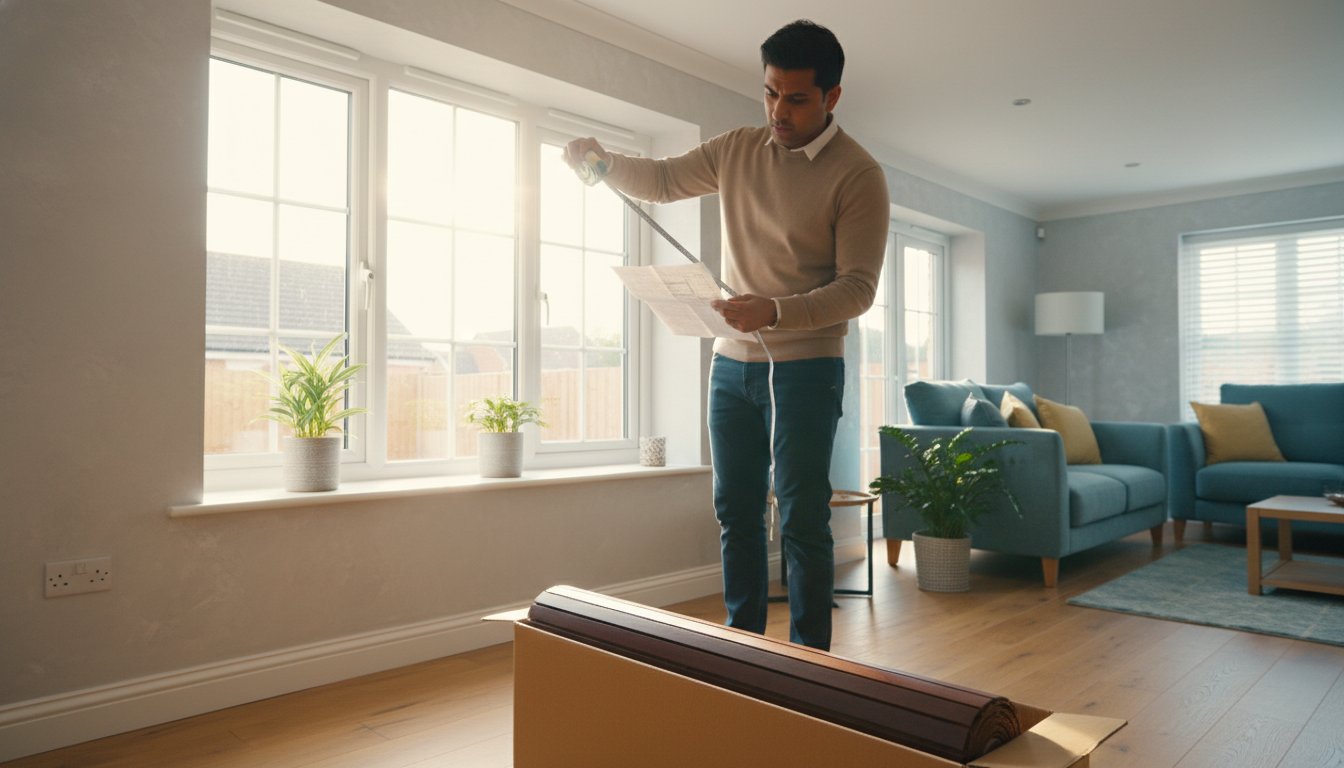
Could a single millimetre really cost you hundreds of pounds? You’ve likely spent hours browsing beautiful fabrics and styles, picturing exactly how your new bespoke blinds will transform your room. It’s natural to want to speed up the process by picking up a tape measure yourself. However, the risk of measuring for blinds myself often turns a simple home update into an expensive and frustrating headache.
We understand the desire for a quick result, but window frames are rarely as straight as they appear. This article will show you why professional precision is the only way to guarantee a perfect fit and how you can avoid the financial gamble of non-returnable errors. We’ll explore the technical pitfalls of DIY measuring, from the confusion over recess versus exact sizes to the nightmare of non-square window frames, and explain how a local expert ensures your window coverings look stunning and professional without the stress.
Key Takeaways
- Understand why standard tape measures are often unsuitable for the millimetre-perfect accuracy required for bespoke window coverings.
- Identify hidden obstacles like protruding UPVC handles and wall tiles that can prevent your new blinds from operating correctly.
- Learn why the risk of measuring for blinds myself is a high-stakes gamble due to the industry-standard “no return” policies on made-to-measure products.
- Explore the technical challenges posed by non-square window frames and how professional assessment eliminates the guesswork.
- Discover the benefits of a local, heritage-led fitting service that guarantees a flawless finish for your home.
Understanding the Technical Risk of Measuring for Blinds Yourself
Measuring for window treatments often feels like a simple task you can tick off your to-do list in minutes. You pull the metal tape across the width, note the height, and assume the job’s done. However, the technical risk of measuring for blinds myself is found in the difference between a static number and a functional fit. A measurement can be numerically accurate but practically useless if it doesn’t account for how the fabric or slats will actually move within your specific window space.
Precision is everything with bespoke products. Standard household tape measures often have a small amount of “play” in the hooked end, or they may flex slightly over wider spans. These tiny variations can lead to inaccurate millimetre readings that result in a blind that’s either too tight to lower or too small to provide total privacy. Unlike ready-made options that offer a margin for error, a made-to-measure window blind is engineered to your exact data. There’s no room to “trim a bit off” once the product arrives at your door.
To see how a professional UK specialist approaches this measuring process, watch this helpful guide:
Recess vs. Exact: The First Hurdle
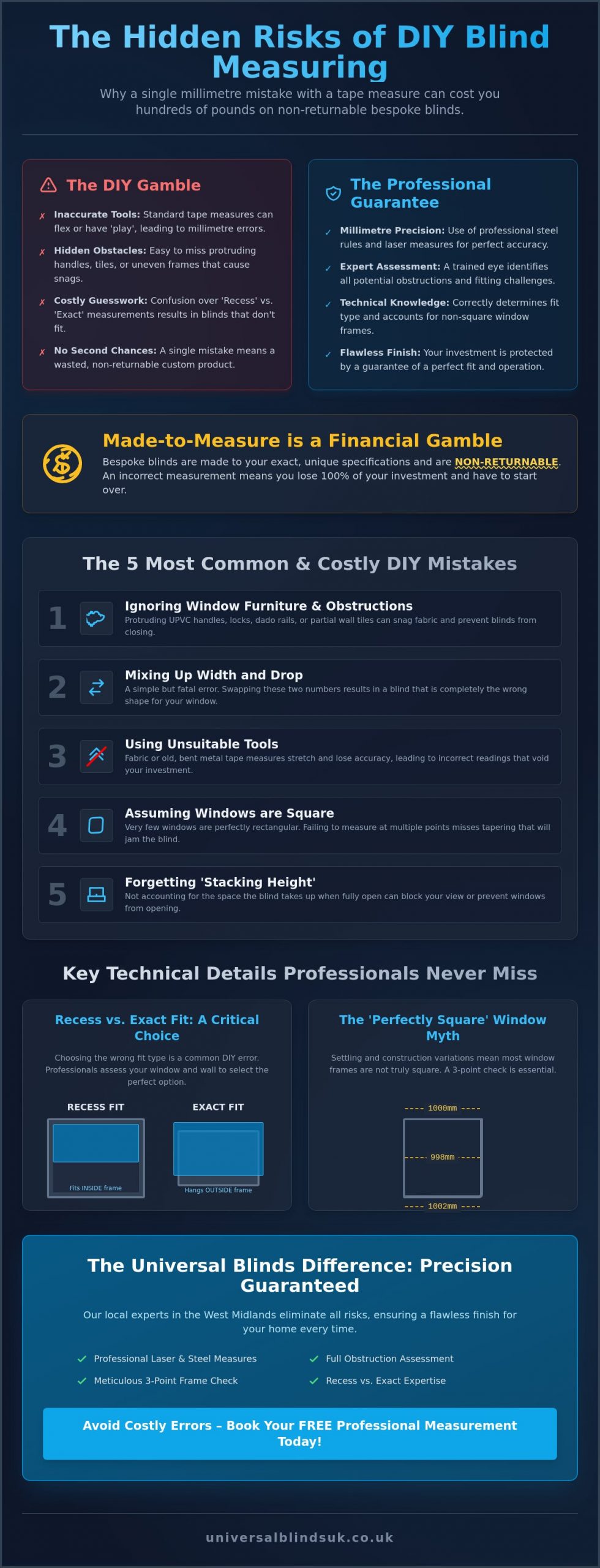
Choosing between a ‘recess’ and an ‘exact’ measurement is where many DIY projects stumble. A recess measurement tells the manufacturer to subtract a specific amount of clearance so the blind fits inside the window opening. If you provide an ‘exact’ measurement by mistake, your blind will arrive far too large for the space. Conversely, measuring for an ‘exact’ fit is used when you want the blind to hang outside the window frame to block more light. Our professional fitters determine the best approach by assessing your wall type and lintel depth to ensure the brackets have a secure, long-term home.
The Illusion of the Square Window
It’s a common misconception that window frames are perfectly rectangular. In reality, very few windows in the UK are truly square. This is especially true for the beautiful heritage homes across the West Midlands, where decades of building settling can cause subtle shifts. If you only measure the width at the top, you might miss a narrowing at the bottom that prevents the blind from closing. We use a rigorous three-point check, measuring the top, middle, and bottom of every frame. This process identifies “tapering” or “bowing” that the naked eye simply cannot see, ensuring your bespoke blinds hang straight and operate smoothly every time.
The 5 Most Common DIY Measuring Mistakes Homeowners Make
While many people feel confident tackling home renovation tasks, bespoke window coverings require a level of precision that goes beyond basic handyman skills. The risk of measuring for blinds myself often comes down to five recurring errors that can render a custom product unusable. First, homeowners frequently overlook window furniture. If a handle or lock protrudes even slightly, it can snag the fabric or prevent a blind from closing. Second, wall obstructions like dado rails or picture rails are often ignored, leading to a fit that looks cluttered or uneven.
The third mistake is perhaps the most frustrating: mixing up width and drop. It sounds simple, but swapping these two numbers is a fatal error because bespoke blinds are cut to your specific dimensions and cannot be resold. Fourth, many people use fabric tape measures. These are designed for dressmaking and can stretch over time, leading to inaccurate results. Finally, failing to account for ‘stacking height’ is common. This is the space the blind occupies when it’s fully open. If you don’t plan for this, your beautiful new blinds might block your view or prevent your window from opening properly.
Obstructions: The Hidden Blind Killers
Modern UPVC windows often feature handles that stick out significantly from the frame. If you measure for a roller blind without accounting for this protrusion, the fabric will bunch up every time you try to lower it. Partial tiling in kitchens and bathrooms also creates a major headache. If your window is tiled halfway up, the recess width will be narrower at the bottom than at the top. Professional fitters also look for window vents and alarm sensors, ensuring the depth of the recess is sufficient for the blind’s mechanism to operate without hitting these fixtures. To explore how high-quality window treatments are designed to navigate these architectural challenges, you can learn more about the custom solutions provided by industry experts.
Tool Failure: Why Your Tape Measure Might Lie
Precision is non-negotiable. Cheap tape measures often have a loose ‘hook’ at the end. While this is meant to allow for its own thickness, a poorly made tool can give you a reading that is two or three millimetres off. There’s also the issue of parallax error, which happens when you read the tape from an angle rather than straight on. Our experts use professional steel rules and laser measures for high ceilings or wide spans to eliminate these tiny discrepancies. If these technicalities feel overwhelming, our professional fitting service takes the guesswork out of the process entirely.
Why ‘Made-to-Measure’ Makes DIY Measuring a Financial Gamble
When you purchase a standard product from a high street retailer, you usually have the safety net of a return policy if the item doesn’t suit your needs. Bespoke window coverings are entirely different. Every set of made-to-measure blinds is engineered to your specific millimetre requirements. Because these products are unique to your home, they cannot be resold to another customer. This is why the risk of measuring for blinds myself is essentially a financial gamble with no exit strategy. Once the fabric is cut or the slats are trimmed, the order is final.
Across the UK blinds industry, “No Return” policies for custom orders are the standard. This isn’t a sales tactic; it’s a practical reality of manufacturing personalised goods. If you provide a measurement that is slightly too wide, you’re left with an expensive product that simply won’t fit into your window recess. We often see the ‘Buy Twice’ phenomenon, where a homeowner tries to save money by measuring themselves, makes a tiny error, and then has to pay for a second, professional set. This doubles your total expenditure and turns a home improvement project into a source of significant frustration.
The ‘Measure Twice, Cut Once’ Fallacy
The old saying suggests that double-checking your work prevents errors. While this is true for basic tasks, it doesn’t help if you’re measuring from the wrong point every time. You might be consistently reading the tape measure accurately, but if you’ve missed a hidden lintel or didn’t account for the bracket’s depth, the final product still won’t work. The psychological stress of clicking “order” on a bespoke set worth hundreds of pounds is immense. You can avoid this anxiety by understanding The Benefits of Professional Blind Fitting, where the technical burden is handled by experts.
Insurance and Accountability
The most valuable part of a professional service isn’t just the tape measure; it’s the shift in liability. When you measure yourself, you own the mistake. When a professional from Universal Blinds UK takes the measurements, the responsibility for a perfect fit shifts entirely to us. If a pro-measured blind doesn’t fit for any reason, we fix it or replace it at no additional cost to you. This built-in ‘insurance’ provides a level of security that DIY simply can’t match. It ensures your investment is protected from the moment we arrive at your door in the West Midlands until the final fitting is complete.
Technical Obstacles: Handles, Tiles, and Non-Square Windows
The physical architecture of your home often presents the greatest technical challenge when installing window coverings. While a window might look like a simple opening, the risk of measuring for blinds myself becomes apparent when you encounter modern UPVC fixtures or heritage timber frames. UPVC handles are a prime example. These often protrude several centimetres into the room. If your blind is mounted too close to the glass, it will strike the handle every time you operate it. This creates unnecessary wear on the fabric and prevents the blind from hanging flush against the window.
Inward-opening ’tilt and turn’ windows require even more foresight. If you install a standard roller blind within the recess, you won’t be able to open the window fully without the frame hitting the blind’s mechanism. Professional fitters often suggest face-fixing the blind or using specialist systems that move with the window leaf itself. Similarly, Victorian sash windows often feature deep recesses but incredibly uneven lintels. A blind that is perfectly level at the top might look slanted against a sloping windowsill. Balancing these aesthetics requires a specialist eye and often a few clever adjustments that a DIYer might not consider.
Bay Windows: A Specialist’s Domain
Bay windows are arguably the ultimate challenge for any homeowner. The difficulty lies in the ‘intersection point’ where two separate blinds meet at an angle. If you don’t calculate the bracket depth correctly, the blinds will either clash or leave large, unsightly light gaps in the corners. It is a precise mathematical puzzle that changes depending on whether you choose rollers, verticals, or venetians. To see which designs work best for these complex spaces, consult A Complete Guide to Blind Styles.
Kitchens and Bathrooms: The Tiling Trap
In rooms with moisture, such as kitchens and bathrooms, tiling often creates a ‘stepped’ recess. If you measure the width at the top of the window where there are no tiles, but the bottom half of the window is tiled, your custom blind will be too wide to reach the sill. We also check if walls are ‘plumb’, meaning perfectly vertical. In older West Midlands properties, walls can lean significantly. A professional ensures the blind is centred so that these structural quirks are disguised rather than highlighted. Don’t let technical obstacles ruin your home’s aesthetic. You can book a professional measuring service to ensure every handle, tile, and angle is perfectly accounted for.
The Universal Blinds Difference: Professional Precision in the West Midlands
Universal Blinds UK offers a different approach to window styling. As a family-run, heritage-led business based in Walsall, we understand that your home is your sanctuary. The risk of measuring for blinds myself isn’t just about technical errors; it’s about the loss of peace of mind. We eliminate that anxiety through a customer-centric service that prioritises your comfort over a quick sale. Our “No Pressure” promise means you receive expert guidance from specialists who are invested in their local reputation, not just a commission. We believe in building trust through transparency and helpfulness.
During a free in-home consultation, we don’t just pull out a tape measure. We conduct a full technical assessment of your window frames, checking for the structural quirks, protruding handles, and uneven lintels mentioned earlier in this guide. This methodical process ensures that every bespoke product we provide is a perfect fit the first time. You’ll have the opportunity to browse our extensive range of high-quality samples in the very place they will hang. This allows you to see how different textures and colours react to the unique natural light of your room, something an online shop simply cannot replicate.
Expert Advice in Your Own Home
A computer screen can never accurately represent the true hue or weight of a fabric. By seeing our samples against your own walls and furniture, you can make an informed decision without the guesswork. Our experts also identify the most suitable blind type for your window’s specific orientation. For example, a south-facing room in a traditional West Midlands terrace might require different light-filtering properties than a modern apartment. This local knowledge is invaluable for achieving both style and functionality in your home.
Stress-Free From Start to Finish
The journey with us is designed to be logical and reassuring. It begins with your initial interest and moves through a decision-making support phase, a technical assessment, and finally, a professional installation. Unlike national brands that focus on DIY kits, we provide a personal touch that ensures total accountability. If we measure it, we own the result. This complete service cycle removes the technical burden from your shoulders and replaces it with the confidence that your bespoke blinds will look elegant and operate perfectly. We are here to guide you through the process with calm expertise.
Book your free home consultation with Universal Blinds UK today and experience the ease of professional precision from a local team you can trust.
Secure Your Perfect Fit Without the Stress
Choosing bespoke window coverings should be an exciting transformation for your home, not a source of anxiety. We’ve explored how a single millimetre discrepancy or an overlooked window handle can turn a beautiful investment into a costly error. Because made-to-measure products are non-returnable, the risk of measuring for blinds myself is a gamble that few homeowners want to take. Professional precision ensures your blinds operate smoothly and look stunning from the moment they’re installed.
As a family-run business with deep local heritage in Walsall, Universal Blinds UK provides the expert support you need. Our team handles every technical detail, from the initial assessment to the final implementation. You’ll enjoy a low-stress experience with our free, no-obligation in-home consultations, which include expert fitting for every bespoke order. Let us take the weight off your shoulders and ensure your windows are finished to the highest professional standard.
Book Your Free Professional Measuring Appointment in the West Midlands
We look forward to helping you find the perfect match for your space and ensuring your home looks its absolute best.
Frequently Asked Questions
What happens if I measure my blinds wrong for a made-to-measure order?
You are usually responsible for the full cost of a replacement if the measurements you provide are incorrect. Since bespoke blinds are cut to your specific dimensions, they cannot be resold or returned under standard UK consumer law for custom-made goods. This financial liability is the primary risk of measuring for blinds myself, as even a tiny error can render the product unusable for its intended window.
Is it worth paying for professional blind measuring?
Yes, because it provides a guarantee of a perfect fit and shifts the liability for any errors from you to the company. Many specialist providers, including Universal Blinds UK, offer this as a complimentary part of their service. By choosing a professional, you avoid the frustration and expense of “buying twice” if a DIY measurement goes wrong, ensuring your window coverings look elegant and function perfectly.
Can I use a digital laser measurer for my window blinds?
Laser measurers are highly accurate but require a steady hand and a clear “stop” point to be effective. While professional fitters often use high-end laser tools for wide spans or high ceilings, basic household versions can sometimes give false readings if they reflect off glass or glossy tiles. A high-quality steel tape measure is often more reliable for standard residential windows to ensure millimetre precision.
How much clearance should I leave when measuring for a recess fit?
You should not subtract any clearance yourself when ordering made-to-measure blinds. You simply provide the smallest width and drop measurements of the recess, and the manufacturer applies a standard technical deduction to ensure the blind can move freely. If you try to calculate this clearance yourself, you risk the blind being far too small and leaving large, unsightly light gaps at the edges of your window.
Why are my window measurements different at the top and bottom?
Most windows are not perfectly square due to natural building settlement or variations in plastering. It is very common to find a difference of several millimetres across the width or height of a single frame. This is why we always use a three-point measuring system. Identifying these tapers early allows us to recommend the best blind type to disguise the structural unevenness of your home effectively.
What is the most difficult type of window to measure for DIY blinds?
Bay windows are the most challenging due to the complex angles where different blinds meet. Calculating the “intersection point” requires specific technical knowledge to prevent the brackets from clashing or leaving wide gaps in the corners. Other difficult types include Victorian sash windows with uneven lintels and modern tilt-and-turn windows that require precise clearance to open fully into the room without obstruction.
Do professional blind fitters in the West Midlands provide free quotes?
Yes, local specialists like Universal Blinds UK provide free, no-obligation in-home consultations across the West Midlands. This service includes a professional technical assessment, precise measuring, and the opportunity to browse fabric samples in your own room’s natural light. It is a stress-free way to get an accurate price for made-to-measure blinds or custom shutters without any pressure or commitment to purchase.
Can I change my measurements after I have placed a bespoke order?
You generally cannot change measurements once the manufacturing process has begun. Because bespoke blinds are started shortly after an order is confirmed to ensure prompt delivery, the fabric or slats may be cut within hours. This highlights why the risk of measuring for blinds myself is so high; once the order is submitted, any errors you’ve made become a permanent and costly mistake that cannot be undone.